GPT-5.6 Terra vs Gemini 3.1 Pro: Value Tier vs Multimodal Flagship (2026)

We ran OpenAI's GPT-5.6 Terra and Google's Gemini 3.1 Pro side by side. Terra wins price and a fresher cutoff; Gemini wins native multimodal input.
Feature Comparison
| Feature | GPT-5.6 Terra | Gemini 3.1 Pro Preview |
|---|---|---|
| API input price (per million tokens) | $2.00 up to 272K, $4.00 above 272K (verified) | $2.00 up to 200K, $4.00 above 200K (verified) |
| API output price (per million tokens) | $12.00 up to 272K, $18.00 above 272K (verified) | $12.00 up to 200K, $18.00 above 200K (verified) |
| Cached input price (per million tokens) | $0.20 up to 272K, $0.40 above 272K (verified) | $0.20 up to 200K, $0.40 above 200K (verified) |
| Pricing structure | Context-length tiered above 272K tokens | Context-length tiered above 200K tokens |
| AA Coding Agent Index v1.3 (independent, read August 2, 2026) | 55.79 — 20th of 52 (Codex harness, high effort); 62.28 at max effort | 30.34 — 48th of 52 (Gemini CLI harness, high effort) |
| AA Intelligence Index (independent) | 55 | 57 |
| Cost per task, AA Cost per Task chart (10 of the 52 Coding Agent Index v1.3 entries) | No cost published for any of its six entries | About $2.00 per task (Gemini CLI harness, high effort) |
| LMArena Elo (independent, human preference) | Not charted | 1485 |
| SWE-bench Verified (independent vals.ai) | N/A (not submitted) | 80.6% self-reported (DeepMind card), not on vals.ai |
| Input modalities | Text and image in, text out | Text, image, video, audio, PDF in, text out |
| Declared context window | 1,050,000 tokens | 1,000,000 tokens |
| Max output tokens | 128,000 tokens | 64,000 tokens |
| Knowledge cutoff | February 16, 2026 | January 2025 |
| Availability status | Generally available (July 9, 2026) | Preview label (deployed since February 2026) |
| Reasoning control | Low to max (new max level) | Adaptive thinking with an effort dial (defaults high) |
| Native grounding and search | Web search as a callable tool | Native Google Search and Maps grounding (5,000 free per month, then $14 per 1,000) |
| Ecosystem and distribution | OpenAI API, Codex, ChatGPT for Work | AI Studio, Vertex AI, Gemini CLI, Android Studio, Antigravity |
| Self-reported headline benchmark (different suites) | Terminal-Bench 2.1 87.4% (OpenAI) | GPQA Diamond 94.3%, ARC-AGI-2 77.1% (DeepMind card) |
Pricing Comparison
GPT-5.6 Terra
Gemini 3.1 Pro Preview
Detailed Comparison
GPT-5.6 Terra and Gemini 3.1 Pro are the two models compared here. GPT-5.6 Terra is OpenAI's balanced value tier, generally available July 9, 2026, priced at $2.00 per million input tokens and $12.00 per million output tokens up to 272,000 tokens, with a 1,050,000-token context window and text-and-image input. Gemini 3.1 Pro is Google DeepMind's flagship, priced at $2 per million input tokens and $12 per million output for prompts up to 200,000 tokens, with a 1,000,000-token context window and native text, image, video, audio, and PDF input. This is a split verdict. Terra leads on price and a fresher February 2026 knowledge cutoff, double the output ceiling, and a long-context surcharge that starts later. Gemini 3.1 Pro leads on native multimodal input, a marginally higher Artificial Analysis Intelligence Index (57 to 55), and Google ecosystem grounding. Best for value coding and long output: GPT-5.6 Terra. Best for native multimodal and Google-native work: Gemini 3.1 Pro.
Quick Verdict
This is a split verdict between OpenAI's mid-priced value tier and Google's multimodal flagship, and neither wins outright — Terra takes freshness, output length, and the independent coding-agent index, while Gemini 3.1 Pro takes native multimodality, small-context price, and the only LMArena entry. GPT-5.6 Terra went generally available on July 9, 2026, three days before this comparison; Gemini 3.1 Pro has been Google's deployed flagship since February 2026 and sits in our production stack through Google AI Studio and Vertex AI. We have API access to both and have run them side by side, so we scope Terra's hands-on claims to roughly 72 hours of first impressions and lean on attributed third-party benchmarks — Artificial Analysis, LMArena, and vals.ai — wherever our own time is too short. Every figure below carries its source, and self-reported vendor numbers are labeled as such. Here is the short version.
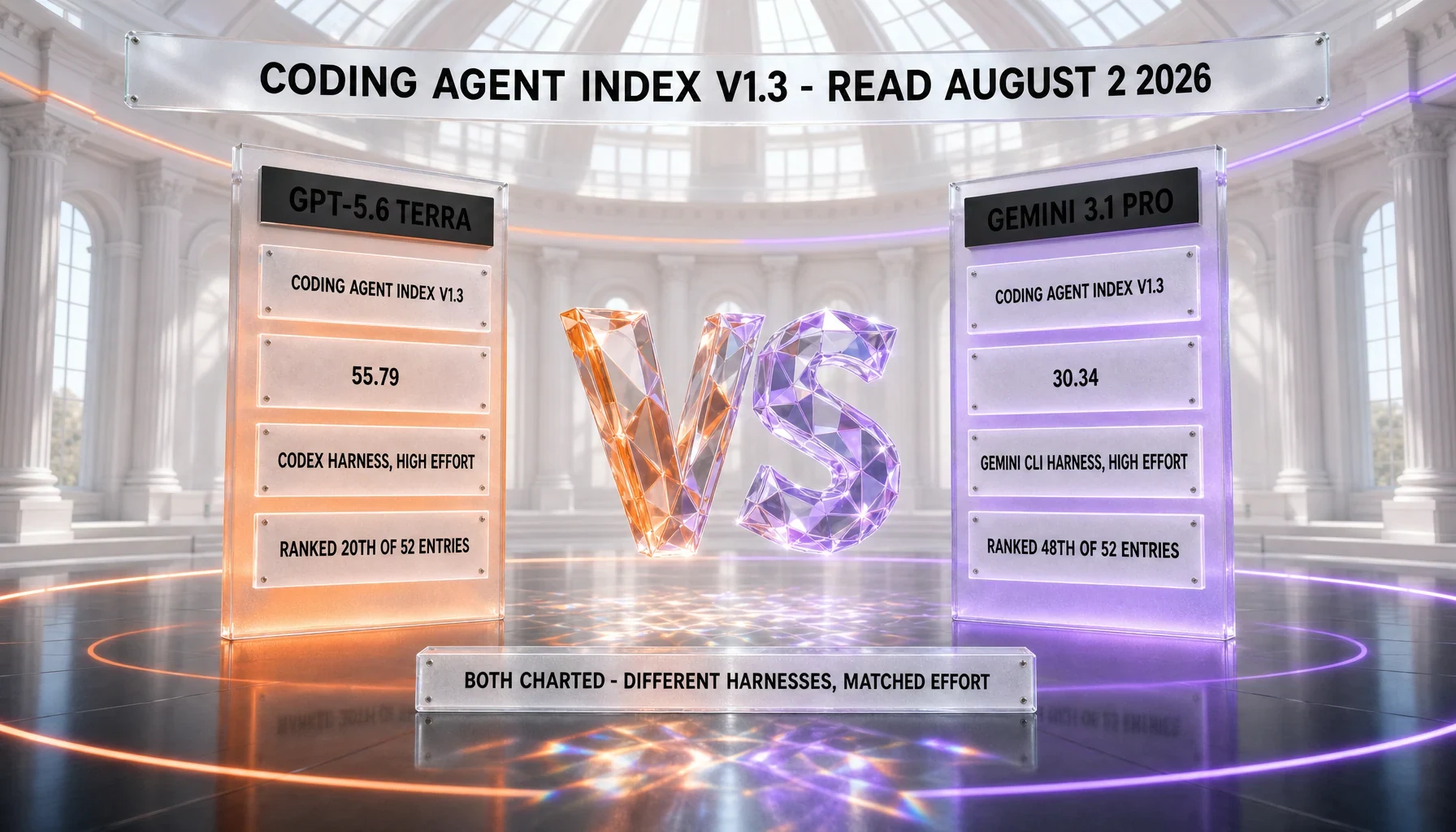
- Best on the independent agentic-coding leaderboard: GPT-5.6 Terra. Artificial Analysis charts GPT-5.6 Terra at 55.79 on the Coding Agent Index v1.3, through the Codex harness at high reasoning effort, against 30.34 for Gemini 3.1 Pro through the Gemini CLI harness at the same effort setting — read August 2, 2026. Each model runs in its own vendor's harness, and the harness is part of the result.
- Best on aggregate intelligence: Gemini 3.1 Pro, marginally. It scores 57 on the Artificial Analysis Intelligence Index against Terra's 55 — a two-point gap that sits inside the noise, measured on different index snapshots.
- Best for standard-tier input price: a tie. Both list $2 per million input tokens; the rates are identical and only the long-context threshold differs — 200,000 tokens on Gemini, 272,000 on Terra.
- Best in the 200,000-to-272,000-token band: GPT-5.6 Terra. Both vendors surcharge long prompts, but Gemini's premium starts at 200,000 input tokens and Terra's at 272,000, so prompts inside that band bill at the standard rate on Terra and the raised rate on Gemini.
- Best for native multimodal input: Gemini 3.1 Pro. It accepts native text, image, video, audio, and PDF; GPT-5.6 Terra takes only text and image. For video and audio understanding in a single call, Gemini is the only option of the two.
- Best for long output: GPT-5.6 Terra. Its 128,000-token output ceiling is double Gemini 3.1 Pro's 64,000, so single very long replies hit the ceiling later on Terra.
- Best for the newest world knowledge: GPT-5.6 Terra. Its knowledge cutoff is February 16, 2026 against Gemini's January 2025 — roughly thirteen months fresher without grounding enabled.
- Best for the Google ecosystem: Gemini 3.1 Pro. Native Google Search and Maps grounding plus first-party distribution across AI Studio, Vertex AI, the CLI, Android Studio, and Antigravity is unmatched by Terra.
- Best for GA contract stability: GPT-5.6 Terra. It is generally available, whereas Gemini 3.1 Pro still carries Google's Preview label, which has a documented shutdown precedent.
The honest caveats up front: Terra has been public for three days, so we treat our hands-on notes as first impressions, not a settled verdict. The two vendors publish different benchmarks, so we compare only where the ground is solid. Neither model has an independently verified SWE-bench score — Terra was not submitted, and Gemini's widely cited 80.6 percent is self-reported on DeepMind's model card, not run by vals.ai. Both models are charted on the Coding Agent Index, each in its own vendor's harness, and Terra is not on the LMArena Elo board that ranks Gemini. We flag every one of those gaps rather than fill it, and we keep self-reported and third-party numbers strictly apart.
GPT-5.6 Terra vs Gemini 3.1 Pro — Overview
What Is GPT-5.6 Terra?
GPT-5.6 Terra is the balanced capability tier of OpenAI's GPT-5.6 generation, generally available July 9, 2026 through the API, Codex, and ChatGPT for Work. In OpenAI's naming scheme the number is the generation and the names — Sol, Terra, and Luna — are durable capability tiers rather than sizes; Terra sits between the flagship Sol and the economy Luna, positioned as GPT-5.5-competitive at two times lower cost, per OpenAI's announcement. We review the tier in depth in our GPT-5.6 Terra review, and its flagship sibling in our GPT-5.6 Sol review. Per OpenAI's model documentation, Terra runs a 1,050,000-token context window with up to 128,000 output tokens and a February 16, 2026 knowledge cutoff, handles text and image input to text output, and offers a reasoning-effort scale from low through xhigh up to the new max level. It ships the full agentic toolbox — Programmatic Tool Calling, where the model writes and runs JavaScript in an isolated, ephemeral runtime, plus function calling, structured outputs, web and file search, code interpreter, hosted shell, computer use, and MCP. API pricing is $2.00 per million input tokens and $12.00 per million output tokens, with cached input at $0.20 per million. Prompts above 272,000 input tokens are billed at twice the input rate and one and a half times the output rate, applied to the full request rather than to the excess. Its predecessor GPT-5.5 remains active for teams already standardized on it.
What Is Gemini 3.1 Pro?
Gemini 3.1 Pro is Google DeepMind's flagship Gemini 3 series model, announced February 19, 2026 and still carrying the Preview label on its gemini-3.1-pro-preview model ID as of July 2026, even as it powers Google's frontier developer surfaces. We review it in depth in our Gemini 3.1 Pro review (our score: 9.0 out of 10). Per Google's model documentation and DeepMind's model card, it runs a 1,000,000-token input context with up to 64,000 output tokens and a January 2025 knowledge cutoff, and it accepts native multimodal input across text, image, video, audio, and PDF, returning text. It uses adaptive thinking shaped by an effort dial rather than an explicit extended-thinking flag, ships native Google Search and Maps grounding as first-party tools, and offers the widest first-party distribution of any frontier vendor — Google AI Studio, Vertex AI, the Gemini API and app, the Gemini CLI, Android Studio, and Antigravity. API pricing uses context-length tiering, which we verified directly on Google's pricing page: $2 per million input tokens and $12 output for prompts up to 200,000 tokens, rising to $4 and $18 above that. For the faster, cheaper sibling model, see our Gemini 3 Flash review.
How We Compared Them — and What We Did Not Do
Method transparency matters more than usual here, because Terra is three days old at the time of writing and the two vendors publish different benchmarks that are easy to conflate. Here is exactly what we did and did not do, so you can weigh every claim below against its source. Our full methodology mirrors what we describe in our agentic coding model explainer.
- Pricing: both rate cards are vendor-verified at the source. Terra's $2.00 input and $12.00 output per million tokens, and its surcharge above 272,000 input tokens, are confirmed against OpenAI's developer pricing page; Gemini 3.1 Pro's tiered $2 and $12 (up to 200,000 tokens) is confirmed against Google's pricing page, including the higher $4 and $18 band above 200,000 tokens. No relayed figures.
- Independent benchmarks: we lean on Artificial Analysis (Intelligence Index and Coding Agent Index) and LMArena (Elo). We only declare a benchmark winner where both models were measured on the same suite under consistent conditions — and we say plainly when only one of them is charted.
- Data gaps we flag rather than fill: neither model appears on the independent vals.ai SWE-bench Verified board. Terra was not submitted; Gemini's 80.6 percent is self-reported on DeepMind's model card. Terra is not on the LMArena board that lists Gemini at 1485. We do not substitute one vendor's number for the other's missing one.
- Self-reported figures: OpenAI's Terminal-Bench 2.1 number for Terra, and DeepMind's GPQA Diamond, ARC-AGI-2, and SWE-bench Verified numbers for Gemini, are labeled as vendor-reported and not treated as head-to-head evidence.
- Hands-on: we have run Gemini 3.1 Pro through Google AI Studio and Vertex AI on our content workflow since April 2026, and Terra for roughly 72 hours since its July 9 GA, side by side on the same business tasks. That is enough for first impressions on Terra, not a controlled benchmark, and we scope every observation accordingly.
- Disclosure: we have no affiliate relationship with OpenAI or Google. There are no sponsored links on this page. Our team uses Gemini 3.1 Pro in production, which is exactly why we have held this comparison to independent, attributed numbers rather than our own habit.
Features and Benchmarks Comparison
The table below lists every dimension we could verify or attribute. Read the Winner column carefully: it distinguishes vendor-verified pricing, independent benchmarks, and self-reported figures, and it marks a tie whenever the two are inside the noise or measured on different suites. A dash means the model is not charted on that board, which we treat as a data gap, not a zero.
| Dimension | GPT-5.6 Terra | Gemini 3.1 Pro | Winner |
|---|---|---|---|
| API input price (per million tokens) | $2.00 up to 272K, $4.00 above 272K (verified) | $2.00 up to 200K, $4.00 above 200K (verified) | Tie |
| API output price (per million tokens) | $12.00 up to 272K, $18.00 above 272K (verified) | $12.00 up to 200K, $18.00 above 200K (verified) | Tie (context-dependent) |
| Cached input price (per million tokens) | $0.20 up to 272K, $0.40 above 272K (verified) | $0.20 up to 200K, $0.40 above 200K (verified) | Tie |
| Pricing structure | Context-length tiered above 272K tokens | Context-length tiered above 200K tokens | GPT-5.6 Terra |
| AA Coding Agent Index v1.3 (independent, read August 2, 2026) | 55.79 (Codex harness, high effort); 62.28 at max effort | 30.34 (Gemini CLI harness, high effort) | GPT-5.6 Terra — 25.45 points clear at matched high effort, in different harnesses |
| AA Intelligence Index (independent) | 55 | 57 | Gemini 3.1 Pro |
| Cost per task, AA Cost per Task chart (10 of the 52 Coding Agent Index v1.3 entries) | No cost published for any of its six entries | About $2.00 per task (Gemini CLI harness, high effort) | Not comparable — a cost is published for one of the two only |
| LMArena Elo (independent, human preference) | Not charted | 1485 | Gemini 3.1 Pro |
| SWE-bench Verified (independent vals.ai) | N/A (not submitted) | 80.6% self-reported (DeepMind card), not on vals.ai | Tie (neither independently verified) |
| Input modalities | Text and image in, text out | Text, image, video, audio, PDF in, text out | Gemini 3.1 Pro |
| Declared context window | 1,050,000 tokens | 1,000,000 tokens | Tie (both 1M-class) |
| Max output tokens | 128,000 tokens | 64,000 tokens | GPT-5.6 Terra |
| Knowledge cutoff | February 16, 2026 | January 2025 | GPT-5.6 Terra |
| Availability status | Generally available (July 9, 2026) | Preview label (deployed since February 2026) | GPT-5.6 Terra |
| Reasoning control | Low to max (new max level) | Adaptive thinking with an effort dial (defaults high) | Tie |
| Native grounding and search | Web search as a callable tool | Native Google Search and Maps grounding (5,000 free per month, then $14 per 1,000) | Gemini 3.1 Pro |
| Ecosystem and distribution | OpenAI API, Codex, ChatGPT for Work | AI Studio, Vertex AI, Gemini CLI, Android Studio, Antigravity | Gemini 3.1 Pro |
| Self-reported headline benchmark (different suites) | Terminal-Bench 2.1 87.4% (OpenAI) | GPQA Diamond 94.3%, ARC-AGI-2 77.1% (DeepMind card) | Tie (not comparable) |
Two asymmetries stand out, and they run in opposite directions. Gemini 3.1 Pro is the only one of the two on the independent human-preference board (LMArena at 1485), where GPT-5.6 Terra is absent; on the independent agentic-coding board — the Coding Agent Index v1.3 — both are charted and Terra leads, 55.79 through the Codex harness against 30.34 through the Gemini CLI harness, both at high effort. The LMArena gap is a difference in what has been measured, not a demonstration that Gemini is the better model; the coding-agent gap is a measured result, and it runs Terra's way. And on aggregate intelligence the two are two points apart on Artificial Analysis, well inside the margin where snapshots flip. This is why the verdict splits rather than crowning one model, and why we lean hard on each vendor's own documentation for the specification rows.
Pricing Comparison
Pricing is where the two models diverge most cleanly, and both rate cards are vendor-verified. Both tier their rates by prompt size; the thresholds differ. We confirmed Terra on OpenAI's pricing page and Gemini on Google's pricing page. For the plain-English version of what input, output, and cached tokens actually mean, see our AI model pricing explainer.
- Standard input: a tie on ordinary prompts. Both cost $2 per million input tokens. Above 200,000 tokens Gemini rises to $4 while Terra holds $2 until 272,000 tokens, so Terra is the cheaper of the two inside that band and the two match again above it.
- Standard output: a tie on ordinary prompts, where both charge $12 per million output tokens. Gemini rises to $18 above 200,000 tokens; Terra holds $12 until 272,000 and then rises to $18 as well, so the only band where the two differ is 200,000 to 272,000 tokens.
- Cached input: both discount cached reads heavily, and both charge $0.20 per million, rising to $0.40 past their respective thresholds. Gemini adds a $4.50 per million tokens per hour cache-storage fee that Terra does not.
- Batch mode: both halve their rates for asynchronous bulk work. Terra's Batch tier is $1.00 input and $6.00 output per million tokens; Gemini's Batch and Flex tiers halve its standard rates similarly.
- Free access: Gemini offers free interactive testing through Google AI Studio but no free tier on the paid API. Terra has no consumer free tier at all — it is an API, Codex, and ChatGPT for Work model, not selectable in the consumer ChatGPT app.
The practical read: on ordinary prompt sizes the two rate cards are identical, so price alone no longer separates them. The one band where Terra is genuinely cheaper is 200,000 to 272,000 input tokens, where Gemini has already stepped up and Terra has not. On an independent basis, Artificial Analysis puts Terra's blended cost at roughly $0.55 per task on its Intelligence Index, which is a different measurement from the Coding Agent Index; the Cost per Task chart Artificial Analysis publishes alongside the Coding Agent Index v1.3 covers only 10 of its 52 entries, and Gemini 3.1 Pro is the one of these two models it includes, at about $2.00 per task through the Gemini CLI harness at high effort; no cost is published for any of GPT-5.6 Terra's six entries, so there is no like-for-like independent cost-per-task figure to set against it.
Winner by Category
Because the two models are strong on different axes, the useful question is not which is better overall but which wins each job. Here is how the categories fall, with the source for each call.
- Agentic coding (independent): GPT-5.6 Terra. Artificial Analysis charts it at 55.79 on the Coding Agent Index v1.3 through the Codex harness at high reasoning effort, against 30.34 for Gemini 3.1 Pro through the Gemini CLI harness at the same effort; Terra's ceiling on that board is 62.28, at max effort.
- Multimodal input: Gemini 3.1 Pro. Native video, audio, and PDF input in a single call is a capability Terra simply does not have — Terra is text and image in, text out.
- Aggregate intelligence: Gemini 3.1 Pro, narrowly. 57 to 55 on the Artificial Analysis Intelligence Index, inside the noise but consistently ahead.
- Human preference: Gemini 3.1 Pro on the record, because it is charted at 1485 on LMArena and Terra is not charted — an availability of evidence rather than a proven quality gap.
- Long-form output: GPT-5.6 Terra. 128,000 output tokens against 64,000 means longer single replies before hitting the ceiling.
- Freshest built-in knowledge: GPT-5.6 Terra. February 2026 cutoff against January 2025 — about thirteen months fresher without grounding.
- Grounded, up-to-date answers: Gemini 3.1 Pro. Native Google Search and Maps grounding closes the cutoff gap for anyone who enables it.
- Later long-context surcharge: GPT-5.6 Terra. Its premium starts at 272,000 input tokens against Gemini's 200,000.
- Ecosystem depth: Gemini 3.1 Pro. The widest first-party distribution of any frontier vendor, from Vertex AI to Android Studio.
- Contract stability: GPT-5.6 Terra. Generally available, where Gemini 3.1 Pro still carries a Preview label with a real shutdown precedent.
Pros and Cons
GPT-5.6 Terra Pros and Cons
What we like about GPT-5.6 Terra
- Low measured cost per task. About $0.55 to run the Artificial Analysis Intelligence Index, the cheaper of the two on that measurement.
- A later long-context surcharge. $2.00 input and $12.00 output per million tokens up to 272,000 tokens, where Gemini's premium already applies from 200,000.
- Double the output ceiling. 128,000 output tokens against Gemini's 64,000, for long single replies.
- Freshest knowledge cutoff. February 16, 2026, roughly thirteen months newer than Gemini's January 2025.
- Generally available. A GA contract rather than a Preview label, plus the full agentic toolbox including Programmatic Tool Calling.
Where GPT-5.6 Terra falls short
- Text and image input only. No native video or audio, where Gemini accepts both — a hard gap for multimodal workloads.
- Not on the LMArena board. No independent human-preference Elo to weigh against Gemini's 1485.
- No independent SWE-bench Verified score. Terra was not submitted, so on that particular suite its evidence stays vendor-reported — its independent coding evidence is the Coding Agent Index instead, where it scores 55.79 through Codex at high effort.
- Three days old at the time of writing. Our hands-on window is roughly 72 hours, so its behavior over weeks is unproven.
- No consumer app and no fine-tuning. API, Codex, and ChatGPT for Work only, with no fine-tuning support at launch.
Gemini 3.1 Pro Pros and Cons
What we like about Gemini 3.1 Pro
- Native multimodal input. Text, image, video, audio, and PDF in a single call — the clearest capability Terra cannot match.
- Matching standard-tier input. $2 per million input tokens up to 200,000 tokens, level with Terra, with Batch halving it again.
- Marginally higher aggregate intelligence. 57 on the Artificial Analysis Intelligence Index against Terra's 55, and charted at 1485 on LMArena.
- Native Google Search and Maps grounding. 5,000 free prompts per month, then $14 per 1,000 queries, for sourced answers without a retrieval pipeline.
- Deepest first-party distribution. AI Studio, Vertex AI, Gemini CLI, Android Studio, and Antigravity — the widest integration story of any frontier vendor.
Where Gemini 3.1 Pro falls short
- Half the output ceiling. 64,000 output tokens against Terra's 128,000, so long single replies hit the wall earlier.
- Older knowledge cutoff. January 2025 against Terra's February 2026 — roughly thirteen months behind without grounding enabled.
- Still a Preview model. Google's Preview label carries change-management risk, with a real shutdown precedent from March 2026.
- Preview status. Google's Preview label carries change-management risk on its own — see the shutdown precedent above.
- Context-length surcharge and no free API tier. Prompts above 200,000 tokens cost more per token, and there is no free plan on the paid API.
When to Pick GPT-5.6 Terra vs Gemini 3.1 Pro
Pick GPT-5.6 Terra if...
- Your workload is agentic coding of the kind the AA Coding Agent Index measures: Terra scores 55.79 there through the Codex harness at high effort, against 30.34 for Gemini 3.1 Pro through the Gemini CLI harness at the same effort.
- You generate long single replies and need the 128,000-token output ceiling rather than Gemini's 64,000.
- Your prompts land between 200,000 and 272,000 input tokens, where Terra still bills at its standard rate and Gemini does not.
- The newest built-in world knowledge matters and you cannot always enable grounding — Terra's cutoff is roughly thirteen months fresher.
- You need GA contract stability rather than a Preview model that can change with limited notice.
Pick Gemini 3.1 Pro if...
- Your inputs are multimodal — native video, audio, and PDF in a single call, which Terra cannot accept.
- You need native video, audio, or PDF input, or Google-native grounding, which Terra cannot match at any price.
- You want native Google Search and Maps grounding for sourced, up-to-date answers without building retrieval.
- Your stack is Google-native — AI Studio, Vertex AI, the CLI, Android Studio, or Antigravity give the shortest path to production.
- You want the marginally higher aggregate-intelligence score and a charted human-preference Elo, and can live with the Preview label.
Frequently Asked Questions
Is GPT-5.6 Terra better than Gemini 3.1 Pro in 2026?
It depends on the job, and we will not fake a single overall winner. GPT-5.6 Terra leads where price and freshness matter: it carries a fresher February 2026 knowledge cutoff, double the output ceiling at 128,000 tokens, and a long-context surcharge that starts later than Gemini's. Gemini 3.1 Pro leads on breadth and small-context economics: native multimodal input across text, image, video, audio, and PDF that Terra cannot match, a marginally higher Artificial Analysis Intelligence Index of 57 against 55, a charted LMArena Elo of 1485, matching standard-tier input at $2 per million tokens, and native Google grounding. Best for value coding, long output, and the newest knowledge: GPT-5.6 Terra. Best for native multimodal and ordinary-prompt price: Gemini 3.1 Pro.
How much do GPT-5.6 Terra and Gemini 3.1 Pro cost?
GPT-5.6 Terra costs $2.00 per million input tokens, $0.20 per million cached input tokens, and $12.00 per million output tokens, with prompts above 272,000 input tokens billed at twice the input rate and one and a half times the output rate across the full request — we confirmed this on OpenAI's developer pricing page. Gemini 3.1 Pro uses context-length tiering, which we verified on Google's pricing page: for prompts up to 200,000 tokens it costs $2 per million input and $12 per million output; above 200,000 tokens it rises to $4 input and $18 output, with cached input at $0.20 and $0.40 per million respectively plus a $4.50 per million tokens per hour cache-storage fee. The two rate cards are otherwise identical, so the only band where they differ is 200,000 to 272,000 input tokens, where Terra still bills at the standard rate. Both offer half-price batch modes, and Gemini alone offers free interactive testing through Google AI Studio.
Which is better for coding: GPT-5.6 Terra or Gemini 3.1 Pro?
Both models are charted on the Artificial Analysis Coding Agent Index v1.3, and GPT-5.6 Terra leads. Artificial Analysis puts Terra at 55.79 there, through the Codex harness at high reasoning effort, against 30.34 for Gemini 3.1 Pro through the Gemini CLI harness at the same effort, read August 2, 2026; each model runs in its own vendor's harness, and the harness is part of the result. Terra's ceiling on that board is 62.28, at max effort. On SWE-bench Verified, the independent vals.ai leaderboard lists neither model directly — Terra was not submitted, and Gemini's widely cited 80.6 percent comes from DeepMind's own model card, not an independent run. So the honest picture is: Terra has the stronger independent agentic-coding signal, Gemini has a published SWE-bench Verified number but a self-reported one, and OpenAI's own Terminal-Bench 2.1 figure of 87.4 percent for Terra is also self-reported. If you weight independent agentic-coding results, Terra leads; if you weight vendor model-card SWE-bench numbers, Gemini has one and Terra does not.
Why is Gemini 3.1 Pro's SWE-bench score labeled self-reported?
Because the 80.6 percent SWE-bench Verified figure comes from DeepMind's own model card, not from the independent vals.ai leaderboard that runs the benchmark under controlled conditions. Vendor-reported benchmark numbers are not wrong by default, but they are produced by the vendor with its own harness and prompting, so we label them as self-reported and never present them as third-party evidence. GPT-5.6 Terra, for its part, was not submitted to SWE-bench Verified at all, so it has no independent score either. On the independently run vals.ai board the top entries are other models — such as Claude Fable 5 and Claude Opus 4.8 — neither of which is in this matchup. We keep self-reported and independent numbers strictly apart and flag the gap rather than fill it.
Is Gemini 3.1 Pro really cheaper than GPT-5.6 Terra?
No longer — the two now list the same rates, and we verified both cards at the source. Both charge $2 per million input tokens, $0.20 per million cached input, and $12 per million output tokens on ordinary prompts. Both also surcharge long prompts at twice the input rate and one and a half times the output rate, applied to the full request. The only difference is where that surcharge starts: 200,000 input tokens on Gemini, 272,000 on Terra. So Terra is cheaper strictly inside the 200,000-to-272,000-token band, and the two are level everywhere else. Gemini also charges a cache-storage fee that Terra does not.
Which has the larger context window: GPT-5.6 Terra or Gemini 3.1 Pro?
GPT-5.6 Terra edges it on both context and output, though the context difference is small. OpenAI's model documentation lists Terra at a 1,050,000-token input context with up to 128,000 output tokens and a February 16, 2026 knowledge cutoff. Google's documentation lists Gemini 3.1 Pro at a 1,000,000-token input context with 64,000 output tokens and a January 2025 knowledge cutoff. The 5 percent context difference rarely changes an architecture decision — both handle book-length inputs and large multi-file codebases. The output ceiling is the more meaningful gap: Terra's 128,000 output tokens is double Gemini's 64,000, so tasks that need a single very long reply, such as full-length report generation or large code translations, hit the ceiling earlier on Gemini. Gemini's answer is its context caching and grounding, which reduce the need to regenerate long outputs from scratch.
What can Gemini 3.1 Pro do that GPT-5.6 Terra cannot?
The clearest capability gap is native multimodal input. Gemini 3.1 Pro accepts text, image, video, audio, and PDF in a single call and returns text, which lets you drop a video walkthrough plus a slide deck into one prompt and get structured output. GPT-5.6 Terra accepts only text and image input to text output — image generation and other modalities are separate callable tools rather than native inputs. Gemini also ships native Google Search and Maps grounding as first-party tools (5,000 prompts per month free across the Gemini 3 family, then $14 per 1,000 queries), and it has the deepest first-party distribution of any frontier vendor, spanning Google AI Studio, Vertex AI, the Gemini CLI, Android Studio, and Antigravity. If your workload is multimodal extraction, retrieval-grounded answering, or anything embedded in the Google Cloud stack, those are real Gemini advantages Terra does not match.
What can GPT-5.6 Terra do that Gemini 3.1 Pro cannot?
Terra's differentiators are output length, freshness, a later long-context surcharge, and general availability. Its 128,000-token output ceiling is double Gemini's 64,000, so it can return much longer single replies. Its February 2026 knowledge cutoff is roughly thirteen months newer than Gemini's January 2025, which matters when you cannot always enable grounding. Its pricing is $2.00 input and $12.00 output per million tokens, and its long-context surcharge starts at 272,000 input tokens rather than Gemini's 200,000. And Terra is generally available as of July 9, 2026, whereas Gemini 3.1 Pro still carries Google's Preview label. It also ships the full agentic toolbox, including Programmatic Tool Calling, where the model writes and runs JavaScript in an isolated, ephemeral runtime. For long-output generation, freshest built-in knowledge, prompts in the 200,000-to-272,000-token band, and GA stability, Terra has the edge.
Is GPT-5.6 Terra multimodal?
Partly. GPT-5.6 Terra accepts text and image input and produces text output. It does not support native audio or video input, and it does not generate images as an output modality — image generation is a callable tool rather than a native output. For document work, its vision input covers scanned pages, charts, and screenshots, which is what Terra's target audience of high-volume business teams typically needs. If your workload requires native video or audio understanding in a single call, Gemini 3.1 Pro is the model of the two that can do it — it accepts text, image, video, audio, and PDF natively. So Terra is multimodal on input in a limited sense (text and image), while Gemini is fully multimodal on input.
Which model is generally available, and does Preview status matter?
GPT-5.6 Terra reached general availability on July 9, 2026, through the API, Codex, and ChatGPT for Work. Gemini 3.1 Pro still carries Google's Preview label, though it has been widely deployed since its February 19, 2026 announcement and powers Google's flagship developer surfaces. Preview status matters for production contracts: pricing, rate limits, model IDs, and response shapes can change with limited notice, and Google has a real precedent here — it shut down the previous Gemini 3 Pro Preview on March 9, 2026 with a forced migration to 3.1. That is a reason to code defensive fallbacks if you build on Gemini 3.1 Pro for mission-critical workloads. In practice the Preview label is not a warning about output quality — the model is battle-tested — but a contractual caveat about change management that a GA model like Terra does not carry.
How does GPT-5.6 Terra compare to GPT-5.6 Sol and Gemini 3 Flash?
Terra is the balanced middle tier of OpenAI's GPT-5.6 family. Above it, GPT-5.6 Sol is the flagship at $4 input and $20 output per million tokens, scoring higher on independent benchmarks (59 on the Artificial Analysis Intelligence Index against Terra's 55) and adding an ultra multi-agent reasoning mode — see our GPT-5.6 Sol review for that tier. On the Google side, Gemini 3 Flash is the faster, cheaper sibling of Gemini 3.1 Pro, aimed at high-volume tasks that do not need the Pro tier's reasoning depth. If you are choosing within one family, the pattern is to route routine work to the cheaper tier (Terra or Gemini 3 Flash) and reserve the flagship (Sol or Gemini 3.1 Pro) for the hardest tasks. This comparison is specifically Terra against Gemini 3.1 Pro — a value tier against a flagship — which is why the verdict splits by workload rather than by raw capability.
Can GPT-5.6 Terra and Gemini 3.1 Pro work together in the same stack?
Yes, and a split stack is a rational setup given how differently they are strong. A practical routing pattern sends long-output generation and anything needing the freshest built-in knowledge to GPT-5.6 Terra, and sends multimodal work, ordinary-sized cost-sensitive prompts, and Google-grounded retrieval to Gemini 3.1 Pro, where it is cheaper on input and accepts native video and audio. Abstraction layers such as the Vercel AI SDK, LangChain, or LiteLLM turn cost-and-capability routing by task type into a configuration exercise rather than a rewrite. Because the two lead on different axes — Terra on coding value and output, Gemini on modality and small-context price — they are genuinely complementary, and many teams already run one of each and route by workload rather than standardizing on a single model.
Final Verdict — A Split Between Value Coding and Multimodal Breadth
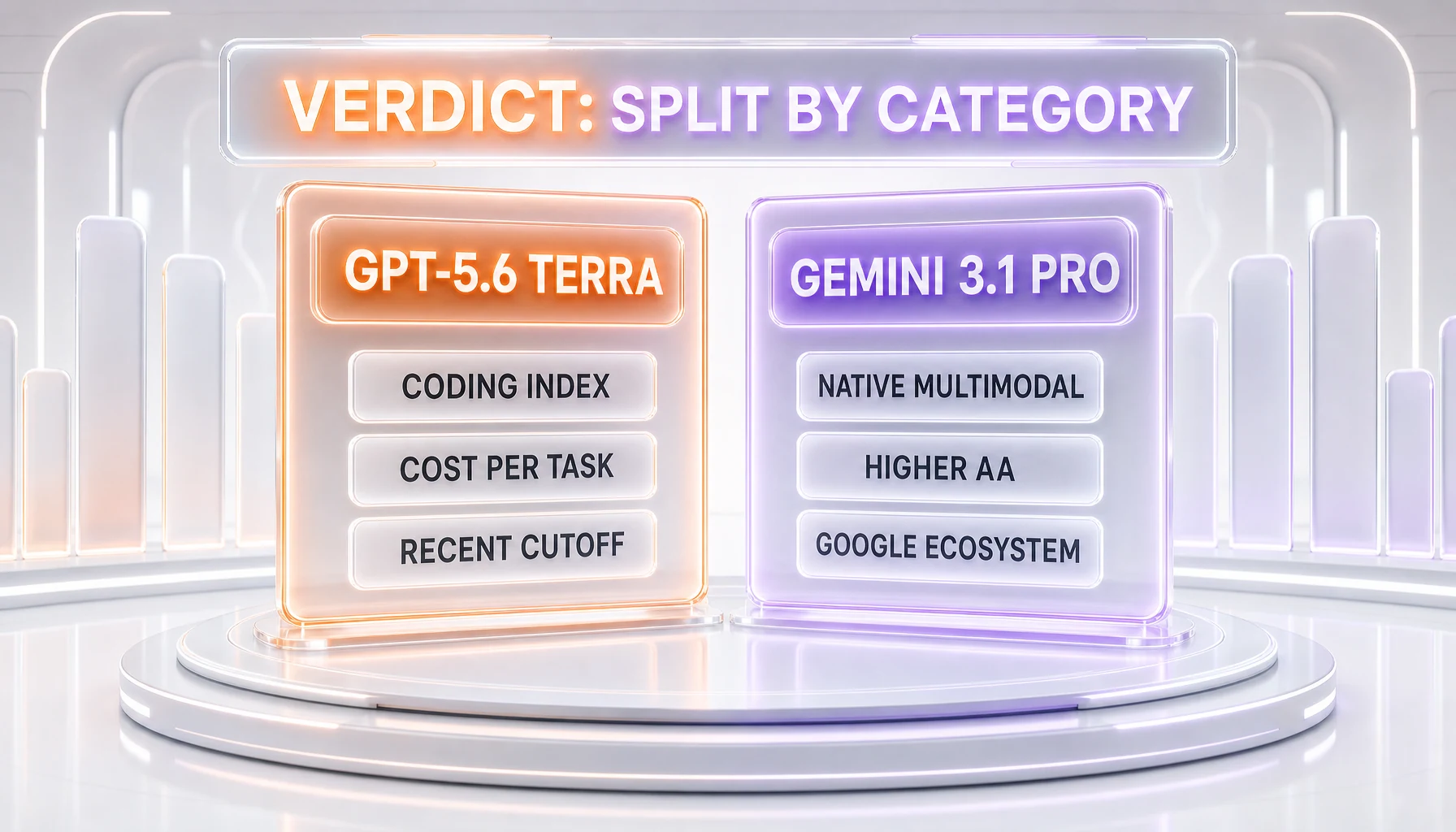
After running both side by side, verifying pricing on both vendors' own documentation, and holding every capability claim to independent benchmarks, our verdict is a genuine split. GPT-5.6 Terra is the value-coding-and-output pick: it carries a low $0.55 cost per task on the Artificial Analysis Intelligence Index, doubles the output ceiling at 128,000 tokens, ships a fresher February 2026 knowledge cutoff, holds its standard rate to 272,000 input tokens where Gemini steps up at 200,000, and comes with GA stability. Gemini 3.1 Pro is the multimodal-and-small-context pick: it accepts native video, audio, and PDF input that Terra cannot, scores marginally higher on aggregate intelligence at 57 to 55, is charted on LMArena at 1485 where Terra is absent, matches Terra on standard-tier input at $2 per million tokens, and plugs into the deepest Google-native grounding and distribution of any vendor. We disclose plainly that our team runs Gemini 3.1 Pro in production — which is exactly why we anchored every capability comparison to third-party numbers rather than our own habit.
We did not crown a single overall winner because the evidence does not support one honestly. The two are two points apart on aggregate intelligence, Terra leads the independent agentic-coding board while Gemini is the only one of the two on LMArena, and neither has an independently verified SWE-bench score. If your work is agentic coding, long-output generation, anything needing the freshest knowledge, or prompts in the 200,000-to-272,000-token band — pick GPT-5.6 Terra. If your work is multimodal or Google-native — pick Gemini 3.1 Pro. For most teams the rational endgame is routing by workload, because each model answers a question the other cannot. For the models one step away from this matchup, see our GPT-5.6 Terra review, our Gemini 3.1 Pro review, our Claude Opus 4.8 review, and our related comparisons: Claude Opus 4.8 vs Gemini 3.1 Pro, Claude Sonnet 5 vs Gemini 3.1 Pro, and Claude Fable 5 vs Gemini 3.1 Pro.
Sources
Every figure in this comparison is attributed to a primary or independent source. Pricing and specifications come from the vendors' own documentation; capability scores come from independent third parties; self-reported figures are labeled as such throughout.
- OpenAI — GPT-5.6 announcement and tier positioning
- OpenAI — GPT-5.6 Terra model documentation and specifications
- OpenAI — GPT-5.6 Terra API pricing (rates and long-context threshold, verified)
- Google — Gemini API pricing (context-length tiers, verified)
- Google — Gemini 3.1 Pro model documentation
- Google DeepMind — Gemini 3.1 Pro model card (self-reported benchmarks)
- Artificial Analysis — Intelligence Index and Coding Agent Index
- LMArena — human-preference Elo leaderboard
- vals.ai — SWE-bench Verified independent leaderboard
Last compared: July 2026. GPT-5.6 Terra reached general availability on July 9, 2026; Gemini 3.1 Pro has been Google's deployed flagship since February 2026 and still carries a Preview label. Both models are moving fast, and we will revise this comparison as independent benchmark coverage matures.
Our Verdict
A split verdict between OpenAI's balanced value tier and Google's multimodal flagship, with no single overall winner. Where GPT-5.6 Terra leads: a low $0.55 cost per task on the Artificial Analysis Intelligence Index; a Coding Agent Index v1.3 score of 55.79 through the Codex harness at high reasoning effort, against 30.34 for Gemini 3.1 Pro through the Gemini CLI harness at the same effort; a February 16, 2026 knowledge cutoff against Gemini's January 2025; double the output ceiling at 128,000 tokens against 64,000; a higher long-context threshold, its surcharge starting at 272,000 input tokens against Gemini's 200,000; and general availability since July 9, 2026. Where Gemini 3.1 Pro leads: native multimodal input across text, image, video, audio, and PDF, where Terra takes only text and image; a marginally higher Artificial Analysis Intelligence Index of 57 against 55; a charted LMArena Elo of 1485, where Terra is not charted; and native Google Search and Maps grounding with the deepest first-party distribution of any frontier vendor. On price the two now list identical rates — $2.00 input, $0.20 cached input, and $12.00 output per million tokens, each doubling on input and rising by half on output above its own long-context threshold. Terra is cheaper only between 200,000 and 272,000 tokens, where Gemini has stepped up and Terra has not. Neither model has an independently verified SWE-bench score: Terra was not submitted, and Gemini's 80.6 percent is self-reported on DeepMind's model card, not run by vals.ai. Best for value coding, long output, the freshest knowledge, and prompts between 200,000 and 272,000 tokens: GPT-5.6 Terra. Best for native multimodal input and the Google ecosystem: Gemini 3.1 Pro. Route agentic coding and long-output work to Terra, and multimodal, small-context, and Google-native work to Gemini 3.1 Pro.
Choose GPT-5.6 Terra
OpenAI's balanced GPT-5.6 tier — GPT-5.5-competitive quality at 40 percent of the GPT-5.5 rate, with a 1.05M-token context and the full agentic toolbox.
Try GPT-5.6 Terra →Choose Gemini 3.1 Pro Preview
Google DeepMind's flagship Gemini 3.1 Pro Preview — 94.3% GPQA Diamond, 77.1% ARC-AGI-2, 1M-token context, multimodal in/text out, vibe coding plus agentic tool use. Preview status as of April 2026.
Try Gemini 3.1 Pro Preview →Frequently Asked Questions
Is GPT-5.6 Terra better than Gemini 3.1 Pro Preview?
A split verdict between OpenAI's balanced value tier and Google's multimodal flagship, with no single overall winner. Where GPT-5.6 Terra leads: a low $0.55 cost per task on the Artificial Analysis Intelligence Index; a Coding Agent Index v1.3 score of 55.79 through the Codex harness at high reasoning effort, against 30.34 for Gemini 3.1 Pro through the Gemini CLI harness at the same effort; a February 16, 2026 knowledge cutoff against Gemini's January 2025; double the output ceiling at 128,000 tokens against 64,000; a higher long-context threshold, its surcharge starting at 272,000 input tokens against Gemini's 200,000; and general availability since July 9, 2026. Where Gemini 3.1 Pro leads: native multimodal input across text, image, video, audio, and PDF, where Terra takes only text and image; a marginally higher Artificial Analysis Intelligence Index of 57 against 55; a charted LMArena Elo of 1485, where Terra is not charted; and native Google Search and Maps grounding with the deepest first-party distribution of any frontier vendor. On price the two now list identical rates — $2.00 input, $0.20 cached input, and $12.00 output per million tokens, each doubling on input and rising by half on output above its own long-context threshold. Terra is cheaper only between 200,000 and 272,000 tokens, where Gemini has stepped up and Terra has not. Neither model has an independently verified SWE-bench score: Terra was not submitted, and Gemini's 80.6 percent is self-reported on DeepMind's model card, not run by vals.ai. Best for value coding, long output, the freshest knowledge, and prompts between 200,000 and 272,000 tokens: GPT-5.6 Terra. Best for native multimodal input and the Google ecosystem: Gemini 3.1 Pro. Route agentic coding and long-output work to Terra, and multimodal, small-context, and Google-native work to Gemini 3.1 Pro.
Which is cheaper, GPT-5.6 Terra or Gemini 3.1 Pro Preview?
GPT-5.6 Terra starts at $2 in / $12 out per M tokens. Gemini 3.1 Pro Preview starts at $2 in / $12 out per M tokens. Check the pricing comparison section above for a full breakdown.
What are the main differences between GPT-5.6 Terra and Gemini 3.1 Pro Preview?
The key differences span across 18 features we compared. For API input price (per million tokens), GPT-5.6 Terra offers $2.00 up to 272K, $4.00 above 272K (verified) while Gemini 3.1 Pro Preview offers $2.00 up to 200K, $4.00 above 200K (verified). For API output price (per million tokens), GPT-5.6 Terra offers $12.00 up to 272K, $18.00 above 272K (verified) while Gemini 3.1 Pro Preview offers $12.00 up to 200K, $18.00 above 200K (verified). For Cached input price (per million tokens), GPT-5.6 Terra offers $0.20 up to 272K, $0.40 above 272K (verified) while Gemini 3.1 Pro Preview offers $0.20 up to 200K, $0.40 above 200K (verified). See the full feature comparison table above for all details.