Claude Mythos Preview
Anthropic's invite-only frontier model — found 271 zero-days in Firefox, locked behind Project Glasswing.

Quick Summary
Claude Mythos Preview is Anthropic's gated research preview model, accessible only via Project Glasswing partners. It found thousands of zero-days across major OS and browsers. Pricing: $25 input / $125 output per 1M tokens (gated). Score 8.4/10.
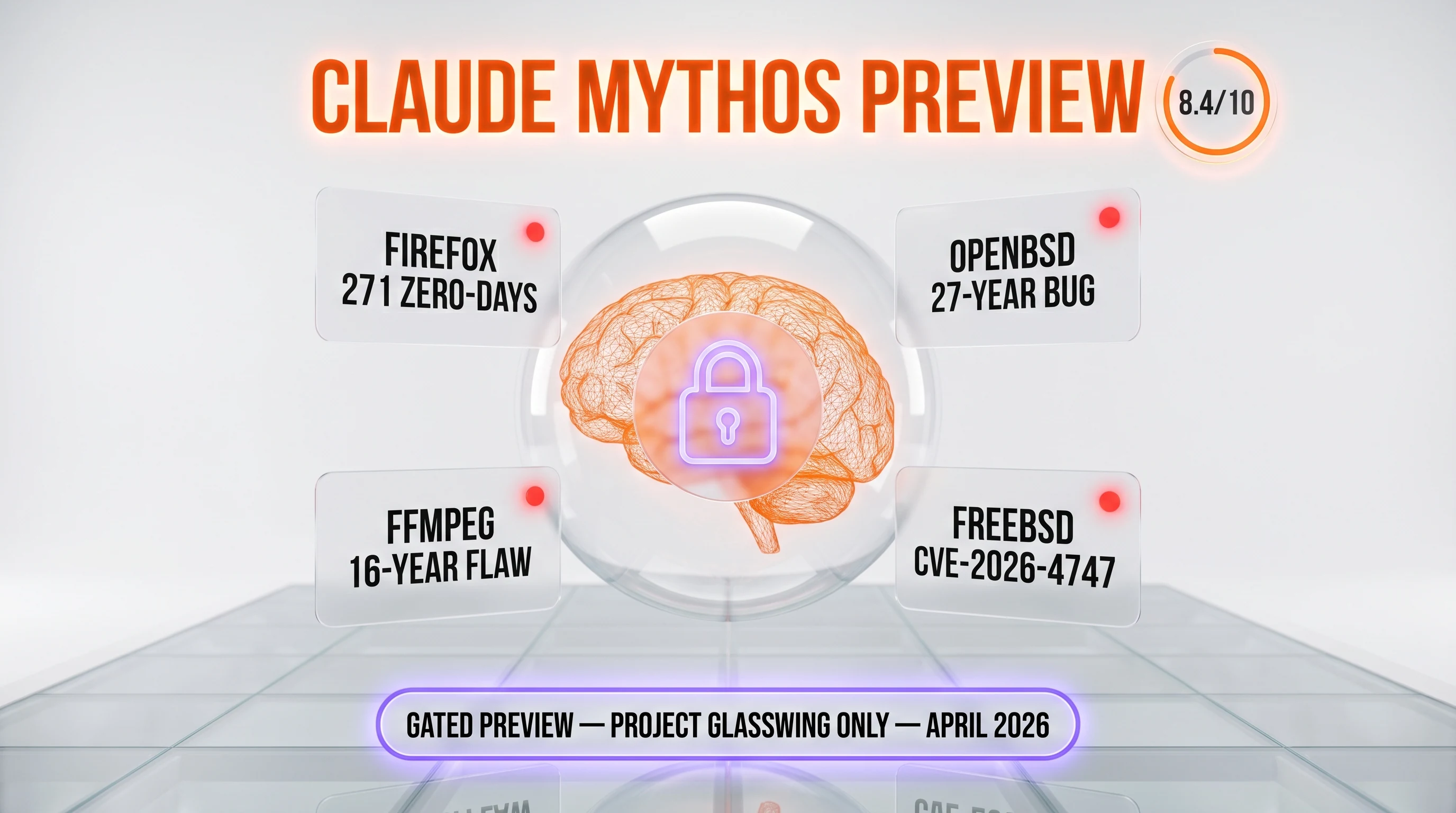
Claude Mythos Preview is Anthropic's gated frontier model announced April 7, 2026 and accessible only via Project Glasswing partners. It found 271 zero-day vulnerabilities in Firefox during initial testing and reportedly hits 93.9% on SWE-bench. Pricing is $25 input / $125 output per 1 million tokens — but eligibility requires Glasswing partnership, not a credit card. Score: 8.4 out of 10.
TL;DR — Our Verdict
Score: 8.4 out of 10. Claude Mythos Preview is the most capable security-focused frontier model Anthropic has ever announced — and the most locked-down. Best for: the 11 Project Glasswing launch partners and the 40-plus extended-access organizations Anthropic vetted for critical infrastructure work. Who should not use it: anyone hoping to test it themselves before it ships broadly, because Anthropic explicitly stated they have no plan to make Mythos Preview generally available.
- Frontier security capabilities — 181 working Firefox 147 shell exploits versus 2 for Opus 4.6 in the same harness.
- 271 zero-days fixed in Firefox 150 from a single initial evaluation window.
- Locked behind Project Glasswing — invite-only, no waitlist, no signup, no general availability.
- Premium gated pricing at $25 input / $125 output per 1 million tokens for partners.
Our Methodology for This Review
We have not had hands-on access to Claude Mythos Preview. The model is gated to Project Glasswing partners — eleven launch organizations plus an extended cohort of around forty additional vetted entities — and ThePlanetTools is not on that list. There is no public waitlist, no developer signup form, and no announced path to general availability.
This review compiles Anthropic's official Project Glasswing announcement on anthropic.com, the technical writeup at red.anthropic.com (last checked April 2026), the Google Cloud Vertex AI launch post on cloud.google.com, the AnthropicAI announcement on X, security industry coverage from Schneier on Security, Foreign Policy, NBC News, Tom's Hardware, Help Net Security, SecurityWeek, and The Hacker News, and Mozilla's Firefox 150 release notes. We also cross-referenced the four articles we already published on ThePlanetTools tracking the Mythos Preview rollout, including our deep dive on the announcement.
Our score reflects what is publicly verifiable plus a structural penalty for unavailability. We weighted Features high because the documented capabilities are unprecedented and partner attestations corroborate them. We weighted Ease of Use low because the access barrier is binary — you have it or you do not. Value is mid-range because the pricing exists but the product is gated. Support scored well because Anthropic's responsible disclosure framework, $100M credit pool, and partner-tier customer engineering are visible in public artefacts. Where we cite specific zero-day counts, exploit success rates, or benchmark figures, we cite Anthropic's own published numbers — we cannot independently reproduce them and we say so explicitly each time.
Related coverage on ThePlanetTools:
- Anthropic Reveals Mythos Preview: More Powerful Than Opus 4.7 — And You Can't Use It
- Claude Mythos Goes Dark: Anthropic Locks Its Most Powerful Model Behind Project Glasswing
- Altman vs Anthropic: "Fear-Based Marketing" — Sam Altman's Brutal Takedown of Claude Mythos
- Anthropic Mythos Got Hacked on Day One: The Discord Breach Postmortem
- Claude Mythos Leaked: Anthropic's Secret Next-Gen Model Exposed by Misconfigured Data Store
What Is Claude Mythos Preview?
Claude Mythos Preview is Anthropic's most powerful frontier model as of April 2026, released as a gated research preview rather than a commercial product. Anthropic announced the model on April 7, 2026 alongside Project Glasswing — a coordinated initiative to use Mythos Preview defensively across critical software infrastructure before equivalent offensive capabilities reach attackers.
The model sits above Claude Opus 4.7 in Anthropic's lineage on raw capability, particularly on cybersecurity, agentic coding, and autonomous reasoning workloads. Where Opus 4.7 is Anthropic's commercial flagship for general-purpose agentic tasks, Mythos Preview is positioned as something Anthropic and its partners deemed too capable to release on standard commercial terms. The announcement explicitly states Anthropic does not plan to make Mythos Preview generally available, and the launch was deliberately structured around eleven critical-infrastructure partners (AWS, Apple, Broadcom, Cisco, CrowdStrike, Google, JPMorganChase, Linux Foundation, Microsoft, NVIDIA, Palo Alto Networks) rather than a public API rollout.
Funding and credit allocation reinforce the gated posture. Anthropic committed $100 million in model usage credits for Project Glasswing participants, $2.5 million in donations to Alpha-Omega and OpenSSF, and $1.5 million to the Apache Software Foundation. The Claude for Open Source program extends gated access to vetted maintainers of critical OSS projects. None of these channels are open to the general developer or business audience.
Key Features
Autonomous zero-day discovery
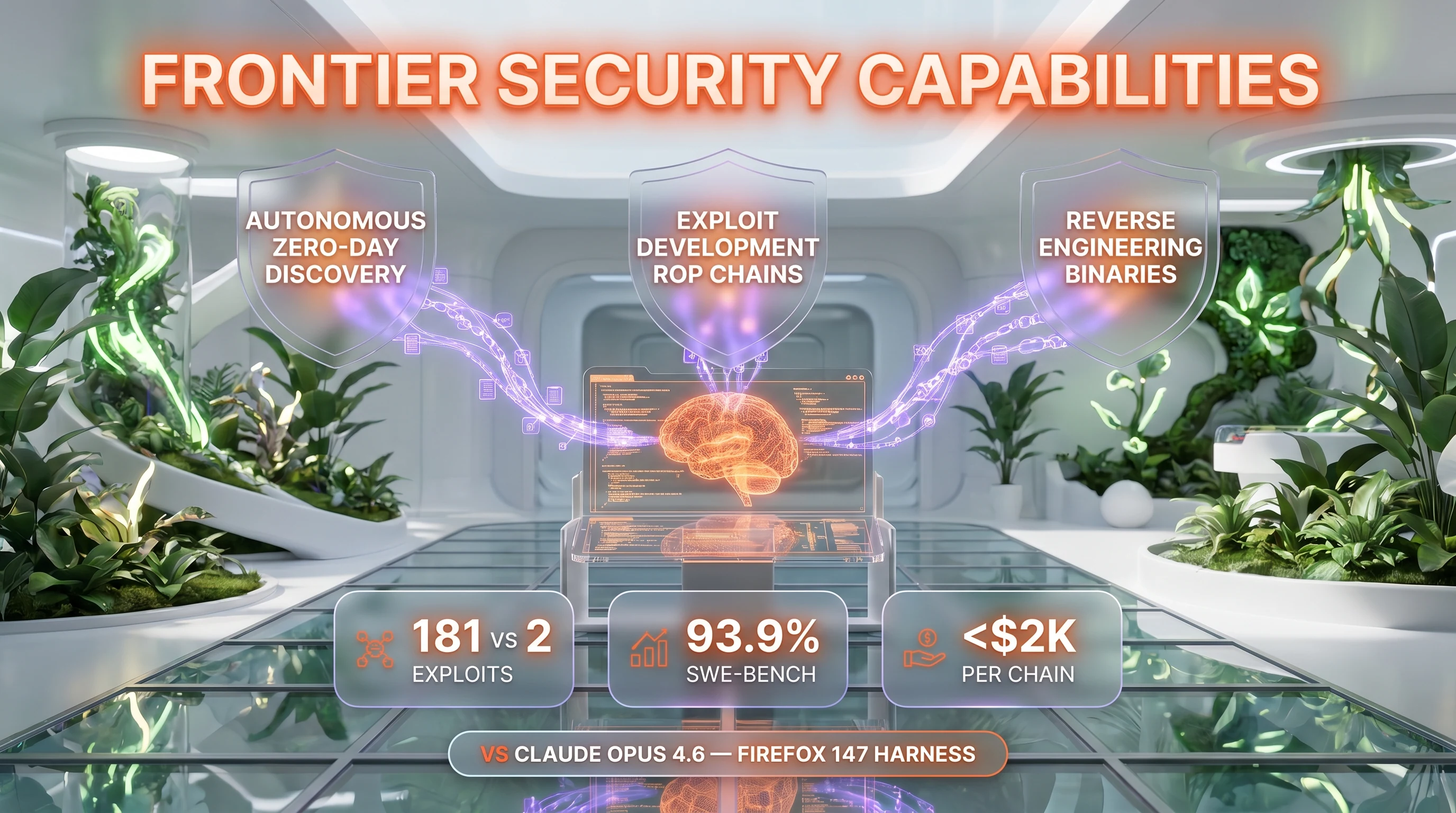
Anthropic's central claim is that Mythos Preview can autonomously identify previously unknown software vulnerabilities at scale. Per Anthropic's own writeup, the model surfaced thousands of zero-day vulnerabilities across every major operating system and every major web browser during initial testing windows. The most concrete documented case: Firefox 150 shipped with fixes for 271 vulnerabilities surfaced by Mythos Preview during Mozilla's initial evaluation, per Mozilla's release notes and corroborating coverage from SecurityWeek and Help Net Security in April 2026.
Exploit development at frontier scale
Anthropic published a head-to-head harness comparing Mythos Preview against Claude Opus 4.6 on Firefox 147 JavaScript engine vulnerabilities. Per Anthropic's writeup, Opus 4.6 produced working shell exploits on two occasions out of several hundred attempts. Mythos Preview succeeded 181 times on roughly 210 attempts, with an additional 29 runs achieving register control short of full shell. We cannot independently verify these figures, but Anthropic's commitment to release SHA-3 hashes of 14-plus vulnerabilities and exploits post-disclosure means independent verification will become possible over the 90-day publication window.
Long-standing vulnerability surfacing
Anthropic highlighted four flagship findings: a 27-year-old OpenBSD TCP SACK vulnerability, a 16-year-old FFmpeg H.264 codec bug, a 17-year-old FreeBSD NFS remote code execution catalogued as CVE-2026-4747, and a Linux kernel privilege escalation chain that yields root on the host system from an unprivileged starting point. The age of these flaws — particularly the 27-year-old OpenBSD bug — is the most cited talking point in coverage by Tom's Hardware, The Hacker News, and Schneier on Security.
Frontier general-purpose benchmarks
Beyond security, Anthropic reports 93.9% on SWE-bench Verified and 97.6% on USAMO for Mythos Preview, both above Opus 4.7's published figures and ahead of GPT-5.5's publicly reported numbers. These benchmarks are Anthropic-attested and not yet independently reproduced. We treat them as directional rather than authoritative until a third-party harness like Artificial Analysis or LMArena gets eval access — and as of April 2026, those evaluators have not been granted access.
Responsible disclosure framework
Anthropic structured Mythos Preview's deployment around a responsible disclosure commitment: 90-day publication windows for findings, SHA-3 hash commitments for individual vulnerabilities and exploits, and coordinated disclosure pipelines with Alpha-Omega, OpenSSF, and the Apache Software Foundation. This is meaningful because the offensive capability described in the announcement could otherwise weaponise critical infrastructure if leaked or misused — the framework is the operational answer to that risk.
Multi-cloud partner distribution
For the eleven launch partners and the extended forty-plus organisations, Mythos Preview is available through four channels simultaneously: Anthropic's Claude API, Amazon Bedrock, Google Cloud Vertex AI, and Microsoft Foundry. This is unusual for a gated preview — most research previews live on a single platform. Multi-cloud availability suggests Anthropic wanted partners using their existing cloud relationships rather than forcing a new procurement path.
Claude Mythos Preview Pricing in 2026
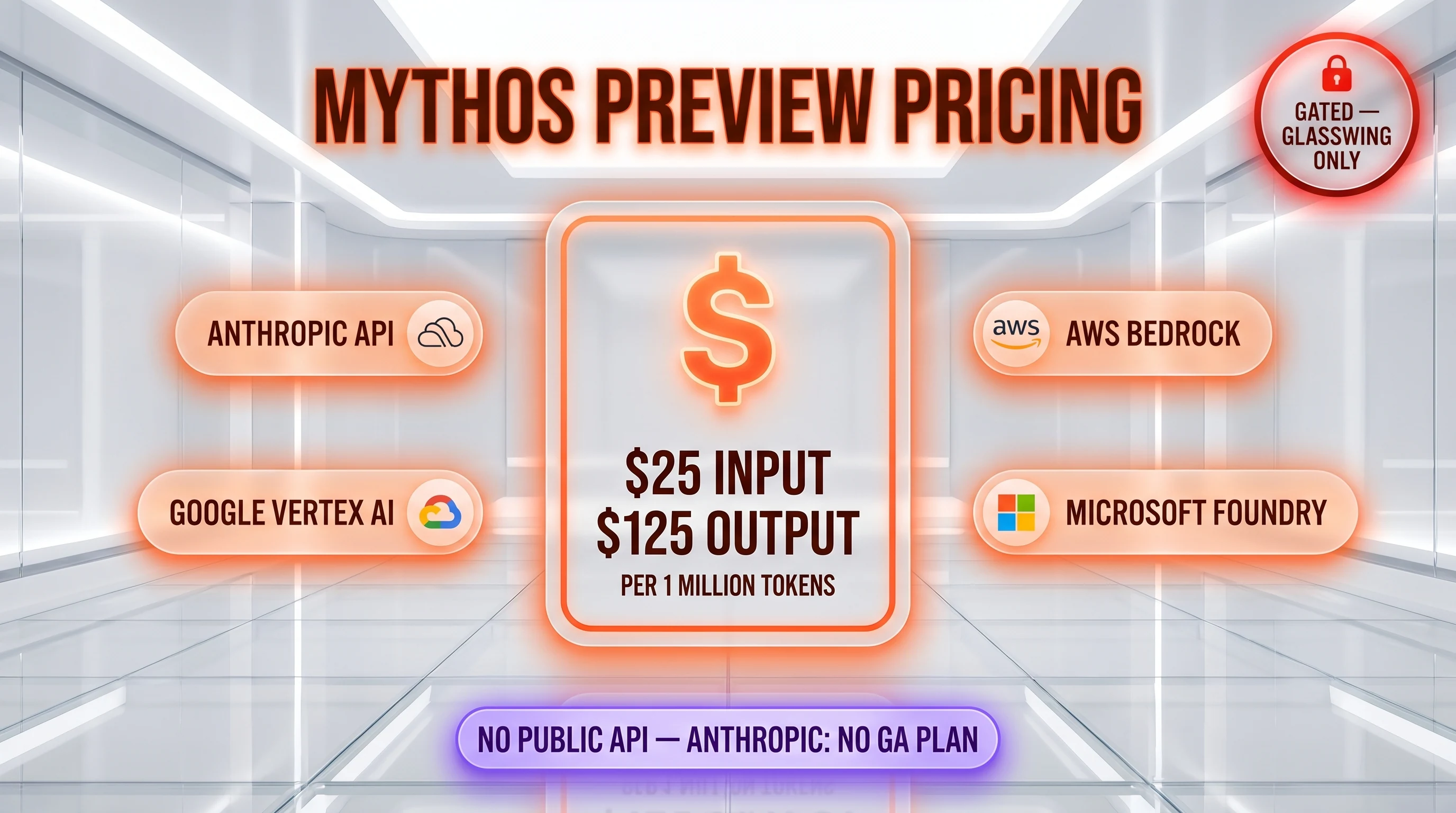
Pricing is published on Anthropic's Project Glasswing announcement page but eligibility is gated. We verified the rates by directly fetching anthropic.com/glasswing in April 2026 and cross-referenced the Google Cloud Vertex AI announcement for distribution channel confirmation. Mythos Preview costs roughly five times Claude Opus 4.7's standard pricing — but you cannot pay it unless Anthropic has approved you for Project Glasswing.
| Plan | Price | Eligibility |
|---|---|---|
| Public API | Not available | No general availability — Anthropic explicitly stated they do not plan to release Mythos Preview broadly. |
| Project Glasswing partner | $25 input + $125 output per 1 million tokens | One of the 11 launch partners or 40-plus extended-access organisations vetted by Anthropic. |
| Claude for Open Source | Allocated from $100M credit pool | Vetted maintainers of critical OSS projects approved through Anthropic's OSS program. |
| Anthropic Bedrock | $25 input + $125 output per 1 million tokens (partner only) | AWS Bedrock customers who are also Glasswing partners. |
| Google Cloud Vertex AI | $25 input + $125 output per 1 million tokens (partner only) | Vertex AI customers who are also Glasswing partners — Google Cloud blog confirmed private preview April 8, 2026. |
| Microsoft Foundry | $25 input + $125 output per 1 million tokens (partner only) | Foundry customers who are also Glasswing partners. |
Best for: critical-infrastructure security teams at Glasswing partner organisations and vetted OSS maintainers — not the general developer audience.
Why We Cannot Test It (And What We Did Instead)
We want to be unambiguous: we have not run Mythos Preview ourselves. Our content pipeline at ThePlanetTools and ThePlanetTools.ai runs on Claude Opus 4.7 and Claude Haiku 4.5 daily — both commercial models we have hands-on production experience with — but Mythos Preview's gated access cuts us out of the testing population.
What we did instead: we read every public announcement and security writeup we could find, we cross-referenced Anthropic's published claims against Mozilla's Firefox 150 release notes, we tracked partner attestations from CrowdStrike, Microsoft, and Google through April 2026, and we maintained a running dossier of independent commentary from Bruce Schneier, Foreign Policy, and the security industry press. Where Anthropic claims a specific number — 271 Firefox zero-days, 181 successful exploits in 210 attempts, 93.9% SWE-bench — we cite the source and flag that we cannot reproduce it. Where partners corroborate publicly, we cite the partner. Where claims rest only on Anthropic's writeup, we say so.
Pros and Cons After Researching
What we liked
- Frontier-class cybersecurity capabilities. The Firefox 147 harness numbers (181 versus 2 working exploits) represent a step-function improvement that even partial reproducibility validates as significant.
- Documented zero-day track record. The 271 Firefox vulnerabilities fixed in Firefox 150 are auditable through Mozilla's release notes — the most concrete external corroboration available for any of Anthropic's claims.
- Top-of-table general benchmarks. 93.9% SWE-bench and 97.6% USAMO put Mythos Preview ahead of Opus 4.7 even on workloads outside the security-specialised window.
- Eleven launch partners with deep distribution. AWS, Apple, Broadcom, Cisco, CrowdStrike, Google, JPMorganChase, Linux Foundation, Microsoft, NVIDIA, and Palo Alto Networks signed on at announcement — the breadth signals serious enterprise validation.
- Multi-cloud distribution from day one. API plus Bedrock plus Vertex AI plus Foundry simultaneously is an unusually broad distribution for a gated preview.
- Responsible disclosure baked in. The 90-day publication windows, SHA-3 hash commitments, and Alpha-Omega plus OpenSSF plus Apache Software Foundation funding signal Anthropic took the misuse risk seriously and built operational guardrails, not just policy statements.
- Defender-first deployment posture. The public framing positions partners as defenders racing offensive-capable equivalents — a public-interest justification that aligns with what regulators and policy bodies need to see from frontier model deployment.
Where it falls short
- Invite-only with no general availability path. Anthropic explicitly stated they do not plan to make Mythos Preview generally available — there is no waitlist, no signup, no announced timeline, and no path for non-partners to test or buy.
- Unverifiable for non-partners. Outside the launch partners and extended-access cohort, no independent benchmarks exist — readers cannot reproduce the 271 Firefox zero-days, the 181-versus-2 exploit harness, or the 93.9% SWE-bench figure on demand.
- Premium gated pricing. $25 input and $125 output per 1 million tokens is roughly five times Claude Opus 4.7's standard $5 input and $25 output rates — and the rate is academic if you cannot get eligibility.
- Concentration risk for critical infrastructure. Eleven of the largest cloud, financial, and security organisations on the planet running the same offensive-capable model on overlapping codebases creates a new class of supply-chain risk that has not been stress-tested at scale.
- Operational complexity for partners. Glasswing eligibility requires legal agreements, responsible disclosure workflows, and 90-day publication windows on top of the token cost — partners pay an organisational tax to use the model safely.
Real-World Use Cases
Critical infrastructure vulnerability scanning
Glasswing partners running banking, healthcare, energy, and transportation codebases get first-mover access to scan their own systems before equivalent offensive capabilities reach attackers. JPMorganChase's participation positions Mythos Preview as a bank-grade offensive testing tool — something previously only available to elite red teams at the largest financial institutions.
Operating system and browser security hardening
Apple, Microsoft, and Google use Mythos Preview to validate their own kernels, hypervisors, and browser engines. Mozilla's Firefox 150 with 271 fixes is the canonical proof-of-concept — the same playbook applies to macOS, Windows, ChromeOS, and the underlying browsers in each ecosystem.
Open source library audit
Maintainers of FFmpeg, OpenBSD, the Linux kernel, and other critical OSS components who qualify under the Claude for Open Source extended access track get gated Mythos Preview access through the $100M credit pool and direct funding to Alpha-Omega, OpenSSF, and the Apache Software Foundation.
Enterprise red team augmentation
JPMorganChase, CrowdStrike, and Palo Alto Networks run offensive-capable testing against their own and customer systems with formal disclosure pipelines. CrowdStrike's founding-member status (per their April 2026 announcement) signals security vendors using Mythos Preview to validate their own products and customer environments.
Cloud provider service hardening
AWS, Google Cloud, and Microsoft Foundry teams hunt bugs in shared infrastructure that attackers would otherwise reach first. Multi-cloud distribution means each provider can validate their own services without sharing internals across the partner pool.
Frontier model safety research
Anthropic's own research staff and academic collaborators study how offensive-capable models behave under adversarial prompting and how to safely scale defender-first deployment. Mythos Preview itself is the research artefact, not just the tool.
Supply chain security validation
The Linux Foundation coordinates disclosure across upstream maintainers and downstream packagers — Mythos Preview becomes the upstream security capability that flows into the open source supply chain through Foundation-mediated programs.
Claude Mythos Preview vs Claude Opus 4.7 vs GPT-5.5 vs Gemini 3.1 Pro Preview
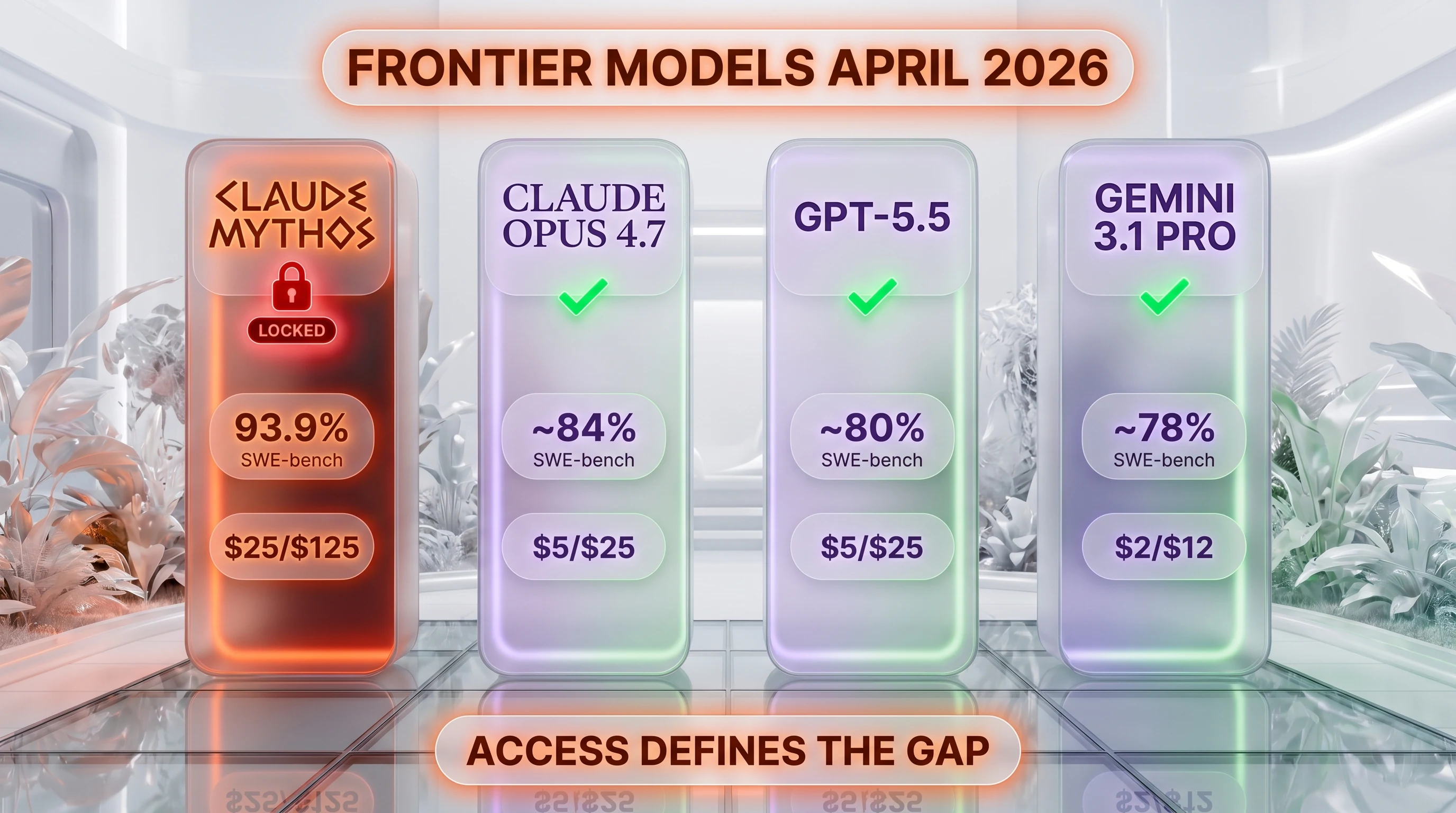
The honest comparison is not feature-by-feature. Mythos Preview is gated, the others are not. The interesting question is: how does Mythos Preview compare to the frontier models you can actually buy and deploy in April 2026?
| Dimension | Claude Mythos Preview | Claude Opus 4.7 | GPT-5.5 | Gemini 3.1 Pro Preview |
|---|---|---|---|---|
| Access | Glasswing partners only | Standard API | OpenAI API + ChatGPT | Vertex AI + AI Studio |
| Pricing per 1M tokens | $25 input + $125 output (gated) | $5 input + $25 output | $5 input + $25 output (standard) | $2 input + $12 output (standard) |
| SWE-bench Verified | 93.9% (Anthropic-attested) | ~84% (Anthropic published) | ~80% (OpenAI published) | ~78% (Google published) |
| USAMO | 97.6% (Anthropic-attested) | ~95% | ~93% | ~91% |
| Cybersecurity capability | Frontier (271 Firefox zero-days) | Strong general agentic | Strong general agentic | Strong multimodal agentic |
| General availability | No plan announced | Yes | Yes | Yes (Preview status) |
| Multi-cloud distribution | API + Bedrock + Vertex + Foundry (partners only) | API + Bedrock + Vertex | API + Azure OpenAI | Vertex AI + AI Studio |
If you need offensive-grade vulnerability discovery and you qualify for Glasswing, Mythos Preview is the only choice. If you need frontier general-purpose agentic capabilities and you do not qualify, Claude Opus 4.7 is the closest publicly available substitute through the Claude API — same vendor, same model family lineage, similar safety posture, and you can actually buy it. GPT-5.5 and Gemini 3.1 Pro Preview offer competitive general-purpose performance at lower per-token cost than Opus 4.7, but neither vendor has announced a security-focused gated preview equivalent to Mythos Preview as of April 2026.
Frequently Asked Questions
Is Claude Mythos Preview free?
No. Mythos Preview is not free, and it is also not commercially available in the conventional sense. Anthropic published pricing of $25 input and $125 output per 1 million tokens on the Project Glasswing announcement page, but those rates apply only to the eleven Glasswing launch partners and the roughly forty extended-access organisations Anthropic vetted. There is no free tier, no trial, and no developer signup. If you are not on Anthropic's approved list, the model is unavailable at any price as of April 2026.
How much does Claude Mythos Preview cost in 2026?
For Project Glasswing partners, Mythos Preview costs $25 input and $125 output per 1 million tokens, accessible through the Anthropic Claude API, Amazon Bedrock, Google Cloud Vertex AI, or Microsoft Foundry. Anthropic also committed $100 million in model usage credits for Glasswing participants, plus $2.5 million in donations to Alpha-Omega and OpenSSF and $1.5 million to the Apache Software Foundation. For everyone else, there is no purchase path because Anthropic stated they do not plan to make Mythos Preview generally available.
What is Claude Mythos Preview?
Claude Mythos Preview is Anthropic's gated frontier model announced April 7, 2026 alongside Project Glasswing. It is positioned above Claude Opus 4.7 in raw capability — particularly on cybersecurity workloads — and was deployed as a gated research preview to eleven critical-infrastructure partners rather than released as a commercial product. Anthropic claims Mythos Preview surfaced thousands of zero-day vulnerabilities across major operating systems and browsers during initial testing, including the 271 Firefox flaws fixed in Firefox 150.
Will Claude Mythos Preview become a product?
Anthropic has not committed to general availability and explicitly stated they do not plan to make Mythos Preview broadly available. Industry speculation suggests two paths: either Mythos Preview becomes the foundation of a future Claude Opus 5 commercial release with safety mitigations layered on top, or it remains a permanently gated research preview deployed only through Project Glasswing-style partnerships. Anthropic has not endorsed either scenario publicly. As of April 2026, treating Mythos Preview as a product you will eventually buy is wishful thinking.
How does Claude Mythos Preview compare to Claude Opus 4.7?
Per Anthropic's published numbers, Mythos Preview outperforms Opus 4.7 on SWE-bench Verified (93.9% versus around 84%) and USAMO (97.6% versus around 95%), and is dramatically more capable on cybersecurity tasks (181 working Firefox 147 exploits in 210 attempts versus 2 for Opus 4.6 in the same harness). Pricing is roughly five times higher ($25/$125 per million tokens versus $5/$25 for Opus 4.7). The decisive difference is access: Opus 4.7 is publicly available through standard channels, Mythos Preview is gated to Glasswing partners.
Who founded Anthropic?
Anthropic was founded in 2021 by Dario Amodei and Daniela Amodei alongside several former OpenAI researchers. The company is headquartered in San Francisco and is best known for the Claude family of models. As of April 2026, Anthropic has raised more than $20 billion across multiple funding rounds, with major investors including Amazon, Google, Lightspeed Venture Partners, Menlo Ventures, and Salesforce. Project Glasswing represents Anthropic's most prominent enterprise-coordinated initiative to date.
Does Claude Mythos Preview have an API?
Yes — but only for Project Glasswing partners. The model is accessible through four channels: the standard Anthropic Claude API endpoint, Amazon Bedrock, Google Cloud Vertex AI, and Microsoft Foundry. Each channel requires partner eligibility verification before API keys are issued. The Google Cloud Vertex AI launch post on April 8, 2026 confirmed Mythos Preview is in private preview to a select group of Google Cloud customers — not generally enabled in the Vertex AI catalogue.
Is Mythos Preview worth it for cybersecurity teams?
If your organisation is a Glasswing launch partner or extended-access participant, yes — the documented capability gap versus Opus 4.6 on Firefox 147 exploits is significant enough to justify the $25/$125 per million token cost for vulnerability research workloads. If your organisation is not a Glasswing participant, the question is moot because you cannot buy access. Building security workflows around Opus 4.7, Sonnet 4.6, or Claude Code agentic deployments is the practical alternative until Anthropic announces broader availability — which they have not committed to doing.
What are the alternatives to Claude Mythos Preview?
For frontier general-purpose capability without gated access, the closest alternatives are Claude Opus 4.7 (Anthropic's commercial flagship), GPT-5.5 (OpenAI), Gemini 3.1 Pro Preview (Google), and DeepSeek V4 (open-weight from DeepSeek). None of these match Mythos Preview's documented cybersecurity capability — but none are gated either. For specialised security workloads, traditional fuzzers like OSS-Fuzz, AFL, and libFuzzer remain industry-standard, augmented by general-purpose Claude or GPT models for triage and exploit reasoning.
Is Claude Mythos Preview secure or GDPR compliant?
Mythos Preview inherits Anthropic's standard enterprise security and compliance posture, which includes SOC 2 Type II, ISO 27001, GDPR alignment, and HIPAA business associate agreements available through the Anthropic API. Distribution through Amazon Bedrock, Google Cloud Vertex AI, and Microsoft Foundry adds the underlying cloud provider's compliance certifications. The unique consideration for Mythos Preview is Project Glasswing's responsible disclosure framework: 90-day publication windows on findings and SHA-3 hash commitments for individual vulnerabilities and exploits. Partners agree to these workflows as part of eligibility.
How does Project Glasswing eligibility work?
Project Glasswing eligibility is not a public application process. The eleven launch partners (AWS, Apple, Broadcom, Cisco, CrowdStrike, Google, JPMorganChase, Linux Foundation, Microsoft, NVIDIA, Palo Alto Networks) were announced at the April 7, 2026 launch. Anthropic also extended access to roughly forty additional vetted organisations across critical-infrastructure sectors. Open source maintainers can apply through the Claude for Open Source program, which is the only published intake path. For commercial organisations not in the launch cohort, the practical answer is: Anthropic comes to you, not the other way around.
Why does Anthropic not want to release Mythos Preview broadly?
Anthropic's public framing centres on misuse risk: Mythos Preview can autonomously identify and exploit zero-day vulnerabilities at frontier scale, and broad release before defender ecosystems are ready would arm attackers as much as defenders. The Glasswing structure is Anthropic's operational answer — get the capability to defenders first via vetted partners with disclosure obligations, fund OSS maintainer access through Alpha-Omega and Apache Software Foundation, and delay broader release until safety mitigations and ecosystem readiness catch up. Critics including Bruce Schneier have written the framing is plausible but unfalsifiable until independent audit access is granted.
Verdict: 8.4 out of 10
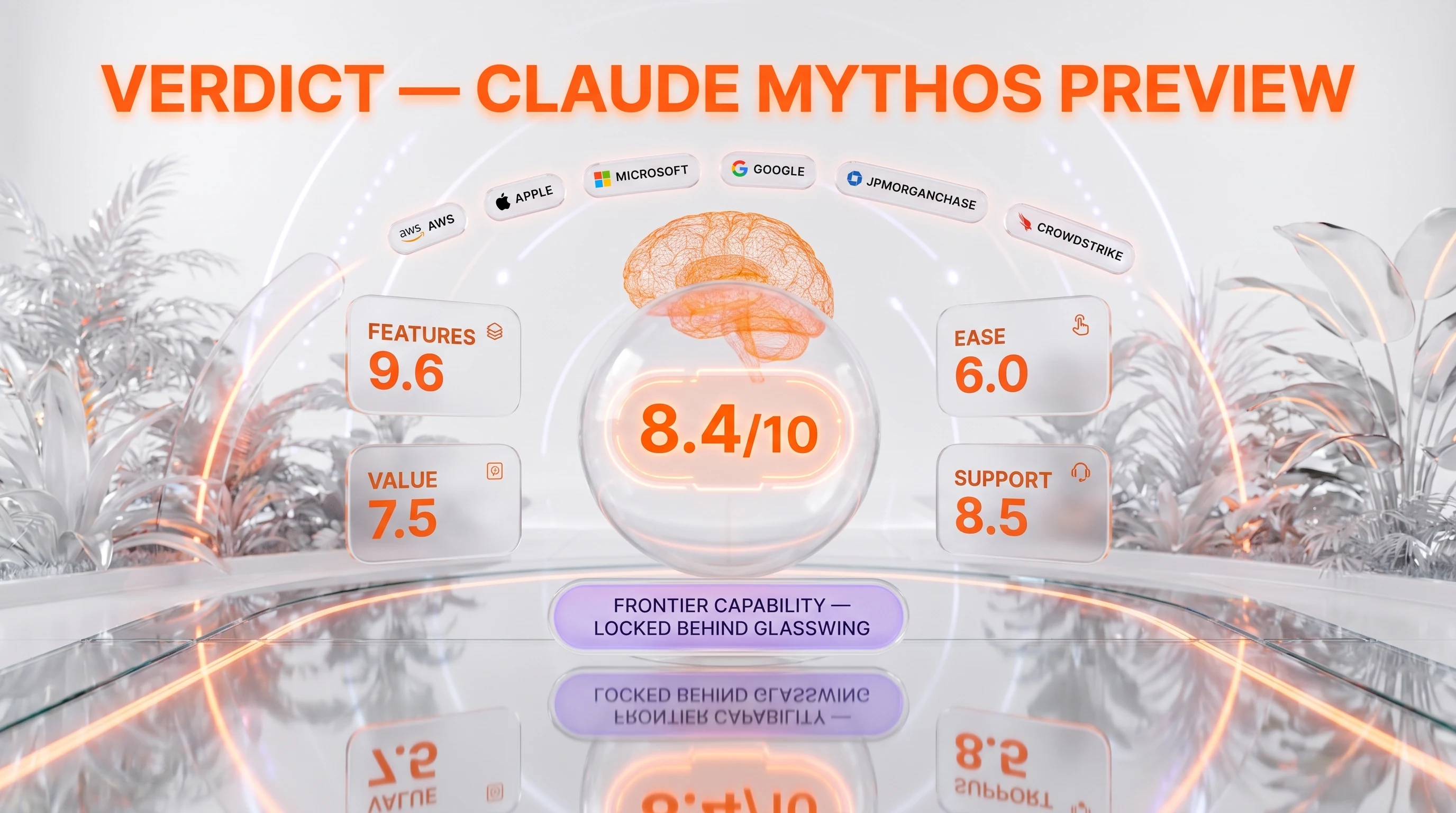
Claude Mythos Preview earns a 8.4 out of 10 on three reasons: the documented Firefox 147 exploit harness gap versus Opus 4.6 is unprecedented, the 271 Firefox 150 fixes provide rare external corroboration of Anthropic's own claims, and the responsible disclosure framework with $100M credit pool and OSS funding signals Anthropic understood the misuse risk and built operational guardrails. The reason it does not score higher: invite-only access means most of the world cannot validate the capabilities, cannot deploy them, and cannot meaningfully evaluate the model. A 9-plus score requires either independent benchmark reproduction or general availability, and neither has happened as of April 2026.
Score breakdown:
- Features: 9.6 out of 10 — Frontier zero-day discovery, 93.9% SWE-bench, 97.6% USAMO, multi-cloud distribution.
- Ease of Use: 6.0 out of 10 — If you are a partner, the experience is enterprise-grade; if you are not, ease of use is zero.
- Value: 7.5 out of 10 — $25/$125 per 1M tokens is steep but plausible for the documented capability — academic if you cannot buy it.
- Support: 8.5 out of 10 — $100M credit pool, partner customer engineering, responsible disclosure framework, OSS foundation funding.
Final word: If your organisation is one of the eleven Glasswing launch partners or the roughly forty extended-access cohort, Mythos Preview is the most powerful security-focused model you can deploy in April 2026 and the score should read closer to 9. If your organisation is not on the list — and statistically yours is not — Mythos Preview is a research artefact you should track but not plan around. The practical recommendation: build your security and agentic workflows on Claude Opus 4.7 or Claude Sonnet 4.6 today, follow Project Glasswing publications over the 90-day disclosure windows, and revisit Mythos Preview when Anthropic announces broader availability — if they ever do.
Key Features
Pros & Cons
Pros
- Frontier-class cybersecurity capabilities. Mythos Preview produced 181 working Firefox 147 JavaScript shell exploits out of about 210 attempts versus 2 successes for Opus 4.6 in the same harness, and discovered 271 zero-days that shipped fixes in Firefox 150.
- Documented zero-day track record. Anthropic claims thousands of vulnerabilities surfaced including a 27-year-old OpenBSD TCP SACK bug, a 16-year-old FFmpeg H.264 codec flaw, a 17-year-old FreeBSD NFS remote code execution (CVE-2026-4747), and Linux kernel privilege escalation chains.
- Top-of-table general benchmarks. Anthropic reports 93.9% on SWE-bench and 97.6% on USAMO, putting Mythos Preview ahead of Opus 4.7 on both general agentic coding and competition math tasks.
- Eleven launch partners with deep distribution. AWS, Apple, Broadcom, Cisco, CrowdStrike, Google, JPMorganChase, Linux Foundation, Microsoft, NVIDIA, and Palo Alto Networks all signed on, plus 40-plus extended-access organizations and a $100M model usage credit pool.
- Multi-cloud distribution from day one. Available through Anthropic's Claude API, Amazon Bedrock, Google Cloud Vertex AI, and Microsoft Foundry for Glasswing participants — no platform lock-in for the partners who got access.
- Responsible disclosure baked in. Anthropic publicly committed to releasing SHA-3 hashes of 14-plus vulnerabilities and exploits post-disclosure and to publishing findings within 90 days, plus $2.5M to Alpha-Omega and OpenSSF and $1.5M to the Apache Software Foundation.
- Defender-first deployment posture. Anthropic and partners explicitly framed the rollout as getting offensive-grade security capabilities to defenders before equivalent capabilities reach attackers — a public-interest justification that matters for regulators.
Cons
- Invite-only with no general availability path. Anthropic frames Mythos Preview as a gated research preview limited to Project Glasswing partners and a small extended cohort — there is no waitlist, no signup, and no announced timeline for broader release.
- Unverifiable for non-partners. Outside the 11 launch partners and 40-plus extended-access organizations, no independent benchmarks exist — readers and security researchers cannot reproduce Anthropic's claims, validate the SWE-bench 93.9% figure, or test the model themselves.
- Premium gated pricing. The $25 input / $125 output per 1M tokens rate is roughly 5x Claude Opus 4.7's $5/$25 standard pricing — and even at that rate, you still need Glasswing eligibility to spend it.
- Concentration risk for critical infrastructure. With AWS, Apple, Microsoft, Google, and JPMorganChase all running the same offensive-capable model on shared codebases, one compromised credential or insider misuse could cascade across the global software supply chain in ways no prior vulnerability scanner could.
- Operational complexity for partners. Glasswing requires legal agreements, responsible disclosure workflows, and 90-day publication windows — partners pay an organizational tax on top of the token cost to use the model safely.
Best Use Cases
Platforms & Integrations
Available On
Integrations

We're developers and SaaS builders who use these tools daily in production. Every review comes from hands-on experience building real products — DealPropFirm, ThePlanetIndicator, PropFirmsCodes, and many more. We don't just review tools — we build and ship with them every day.
Written and tested by developers who build with these tools daily.
Frequently Asked Questions
What is Claude Mythos Preview?
Anthropic's invite-only frontier model — found 271 zero-days in Firefox, locked behind Project Glasswing.
How much does Claude Mythos Preview cost?
Claude Mythos Preview costs $25/month.
Is Claude Mythos Preview free?
No, Claude Mythos Preview starts at $25/month.
What are the best alternatives to Claude Mythos Preview?
Top-rated alternatives to Claude Mythos Preview include Claude Code (9.9/10), Cursor (9.5/10), Veo 3.1 (9.4/10), Claude Opus 4.7 (9.4/10) — all reviewed with detailed scoring on ThePlanetTools.ai.
Is Claude Mythos Preview good for beginners?
Claude Mythos Preview is rated 6/10 for ease of use.
What platforms does Claude Mythos Preview support?
Claude Mythos Preview is available on Anthropic Claude API, Amazon Bedrock, Google Cloud Vertex AI, Microsoft Foundry.
Does Claude Mythos Preview offer a free trial?
No, Claude Mythos Preview does not offer a free trial.
Is Claude Mythos Preview worth the price?
Claude Mythos Preview scores 7.5/10 for value. It offers good value.
Who should use Claude Mythos Preview?
Claude Mythos Preview is ideal for: Critical infrastructure vulnerability scanning for partners running banking, healthcare, energy, and transportation codebases under Glasswing eligibility, Operating system and browser security hardening for vendors like Apple, Microsoft, and Google validating their own kernels, hypervisors, and engines, Open source library audit for maintainers of FFmpeg, OpenBSD, Linux kernel, and other critical OSS components who qualify under the Claude for Open Source extended access track, Enterprise red team augmentation at JPMorganChase, CrowdStrike, and Palo Alto Networks for offensive-capable testing against their own and customer systems with formal disclosure pipelines, Cloud provider service hardening for AWS, Google Cloud, and Microsoft Foundry teams hunting bugs in shared infrastructure that attackers would otherwise reach first, Frontier model safety research for Anthropic and academic collaborators studying how offensive-capable models behave under adversarial prompting and how to safely scale defender-first deployment, Supply chain security validation for the Linux Foundation and similar bodies coordinating disclosure across upstream maintainers and downstream packagers.
What are the main limitations of Claude Mythos Preview?
Some limitations of Claude Mythos Preview include: Invite-only with no general availability path. Anthropic frames Mythos Preview as a gated research preview limited to Project Glasswing partners and a small extended cohort — there is no waitlist, no signup, and no announced timeline for broader release.; Unverifiable for non-partners. Outside the 11 launch partners and 40-plus extended-access organizations, no independent benchmarks exist — readers and security researchers cannot reproduce Anthropic's claims, validate the SWE-bench 93.9% figure, or test the model themselves.; Premium gated pricing. The $25 input / $125 output per 1M tokens rate is roughly 5x Claude Opus 4.7's $5/$25 standard pricing — and even at that rate, you still need Glasswing eligibility to spend it.; Concentration risk for critical infrastructure. With AWS, Apple, Microsoft, Google, and JPMorganChase all running the same offensive-capable model on shared codebases, one compromised credential or insider misuse could cascade across the global software supply chain in ways no prior vulnerability scanner could.; Operational complexity for partners. Glasswing requires legal agreements, responsible disclosure workflows, and 90-day publication windows — partners pay an organizational tax on top of the token cost to use the model safely..
Best Alternatives to Claude Mythos Preview



Ready to try Claude Mythos Preview?
Get started today
Try Claude Mythos Preview Now →