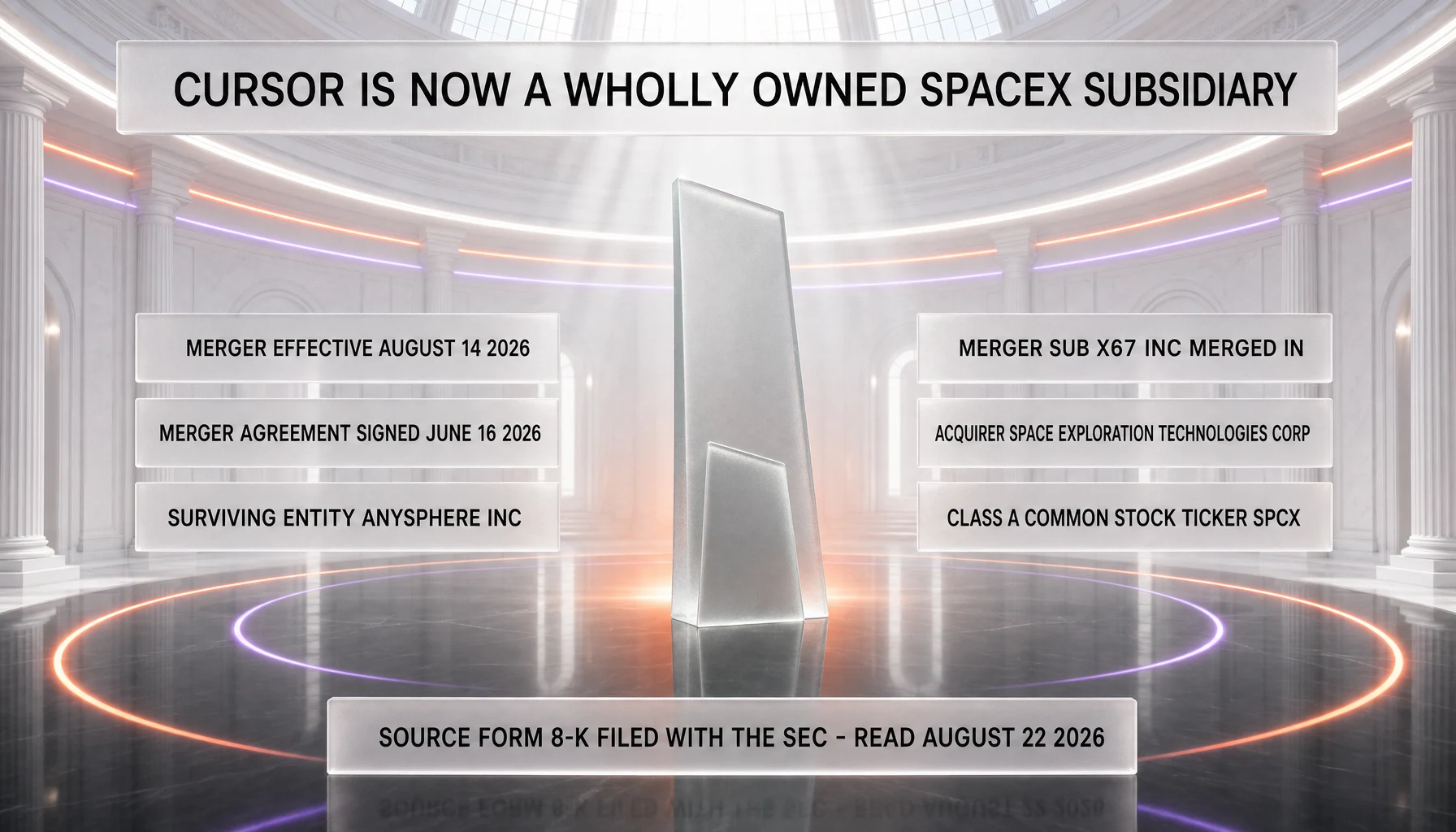
Cursor is no longer an independent company. On August 14, 2026, the merger of SpaceX subsidiary X67 Inc. into Anysphere, Inc. became effective, and Cursor now survives as a wholly owned subsidiary of Space Exploration Technologies Corp. SpaceX disclosed the closing in a Form 8-K filed with the SEC under CIK 0001181412, converting Cursor's stock into 389,289,254 shares of SpaceX Class A common stock at an implied Cursor equity value of $60.0 billion. Cursor confirmed the same day on its own blog, without naming a price. In the nine days from August 12 to August 21, the two organizations released a frontier model under a joint byline, listed Cursor as the provider of a Grok model in its own documentation, and merged their subscription tiers.
We covered the $60 billion agreement to acquire Anysphere when it was announced in June. That article was about a signature: a merger agreement, a set of termination fees reported from the filing, and a list of open questions about what would happen to Cursor as a product. This one is about what the signature produced. The ownership question is settled, the share count is now a matter of public record, and the product questions the June piece left open have started to answer themselves in documentation and pricing pages rather than in press releases.
The closing at a glance
- Effective date: August 14, 2026, per SpaceX's Form 8-K, Item 2.01.
- Structure: X67 Inc., a wholly owned SpaceX subsidiary, merged into Anysphere, Inc.; Anysphere survives as a wholly owned SpaceX subsidiary.
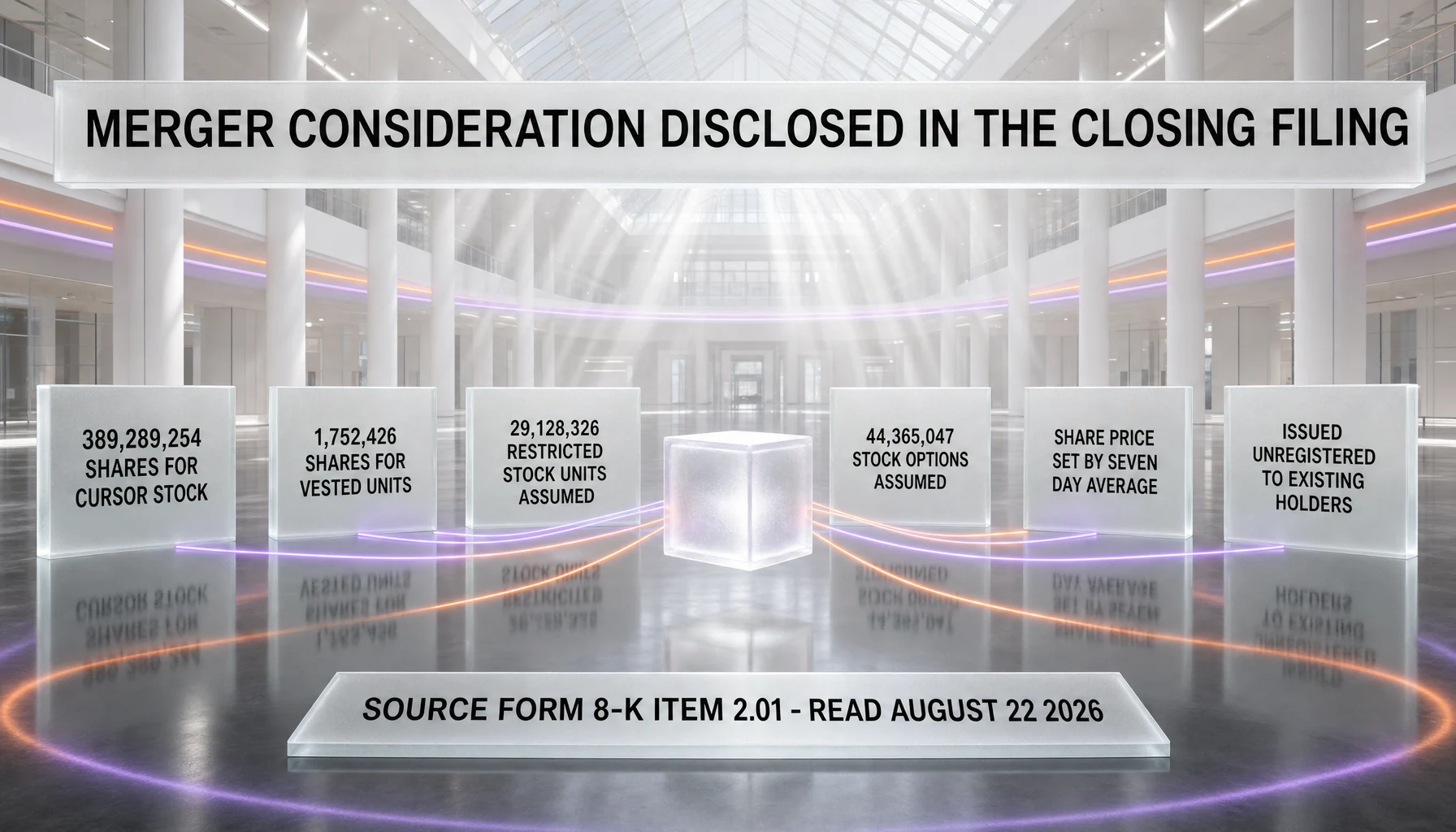
- Consideration: 389,289,254 SpaceX Class A shares for Cursor common and preferred stock, at an implied Cursor equity value of $60.0 billion.
- Vested equity: a further 1,752,426 shares for vested Cursor restricted stock units, before tax withholding.
- Assumed awards: approximately 29,128,326 SpaceX restricted stock units and approximately 44,365,047 options.
- Acquirer: Space Exploration Technologies Corp., Class A common stock trading as SPCX on Nasdaq and Nasdaq Texas.
- Signed by: Bret Johnsen, Chief Financial Officer.
What the closing filing actually establishes
The primary document is a Form 8-K filed by Space Exploration Technologies Corp., a Texas corporation headquartered at 1 Rocket Road, Starbase, Texas, under Commission File Number 001-43344. Item 2.01, "Completion of Acquisition or Disposition of Assets," states that the merger agreement signed on June 16, 2026 among SpaceX, X67 Inc. and Anysphere, Inc. became effective on August 14, 2026, and that Cursor survives the merger as a wholly owned subsidiary.
The share mechanics are unusually specific, and they are worth reading closely because they show how a private-company price gets translated into public-company paper.
| Component | SpaceX Class A shares | Basis stated in the filing |
|---|---|---|
| Cursor common and preferred stock | 389,289,254 | Implied Cursor equity value of $60.0 billion, at a price per SpaceX share equal to the volume-weighted average closing price over the seven consecutive trading days immediately preceding the closing |
| Vested Cursor restricted stock units | 1,752,426 | Before any withholding for applicable taxes; fractional shares paid in cash |
| Unvested Cursor restricted stock units, assumed | approximately 29,128,326 | Converted into SpaceX restricted stock units |
| Cursor stock options, assumed | approximately 44,365,047 | Converted into options to purchase SpaceX Class A common stock |
Two things follow from those numbers. First, the price per share is derivable: dividing the stated $60.0 billion by 389,289,254 shares gives roughly $154 per SpaceX Class A share as the seven-day volume-weighted average used at closing. That figure is our arithmetic from two numbers in the filing, not a figure the filing prints, and the $60.0 billion is stated to one decimal place, so treat it as approximate rather than exact.
Second, the full equity impact is larger than the headline. Adding the 389,289,254 shares issued for stock to the 1,752,426 issued for vested units gives 391,041,680 shares delivered at closing. The assumed unvested units and options add roughly 73,493,373 more shares that may be delivered over time as they vest or are exercised, for a total of about 464,535,053 shares of potential dilution tied to this transaction.
There is one more disclosure worth flagging for anyone tracking SpaceX as a public company. Item 3.02 records the issuance as an unregistered sale of equity securities, made in reliance on the Section 4(a)(2) exemption as a transaction by an issuer not involving a public offering. In plain terms, a newly listed company issued close to 391 million shares without registering them, because the recipients were a defined set of existing Cursor holders rather than the public market.
Three dates that keep getting collapsed into one
This story has three dates, and almost every shorthand version of it merges them. The distinction matters because the $60 billion number belongs to only one of them.
| Date | Event | Where it is documented |
|---|---|---|
| April 2026 | Cursor and SpaceXAI announce a partnership on model training | Cursor's closing blog post, which describes the acquisition process as having "started in April, when we announced our partnership with SpaceXAI" |
| June 16, 2026 | Merger agreement signed among SpaceX, X67 Inc. and Anysphere, Inc. | Filed as Exhibit 10.1 to a Form 8-K on June 16, 2026, and incorporated by reference into the closing filing |
| August 14, 2026 | Merger becomes effective; Cursor becomes a wholly owned subsidiary | Item 2.01 of the closing Form 8-K, and Cursor's own blog post the same day |
On the first of those three dates we are deliberately imprecise, and the reason is worth stating. Cursor's closing post names only the month, "started in April," and we could not locate the original partnership announcement on either the current Cursor blog index or the SpaceXAI news index. We give the month because the month is what the primary source gives. A specific day in April would be a number we cannot source, and this is a story where the dates are the whole difficulty.
The $60.0 billion implied equity value is fixed by the June 16 agreement, not by the August 14 closing. What August 14 determined was the exchange ratio: the filing states the share price was set at the volume-weighted average closing price over the seven consecutive trading days immediately preceding the close. A signed valuation and a floating share price mean the number of shares was unknown until roughly a week before the deal completed, which is why the 389,289,254 figure appears only in the closing filing.
Cursor's own announcement is a two-minute post that does not mention money at all. It reads, in full at the top: "Cursor has officially been acquired by SpaceX. This completes the acquisition process that started in April, when we announced our partnership with SpaceXAI to accelerate our model training efforts." The dollar figure exists only in the SEC filing. If you see the $60 billion attributed to Cursor's announcement, it did not come from there.
Nine days to a shared byline
The clearest evidence that this is an integration rather than a holding-company purchase is not in any filing. It is in who signs the model announcements.
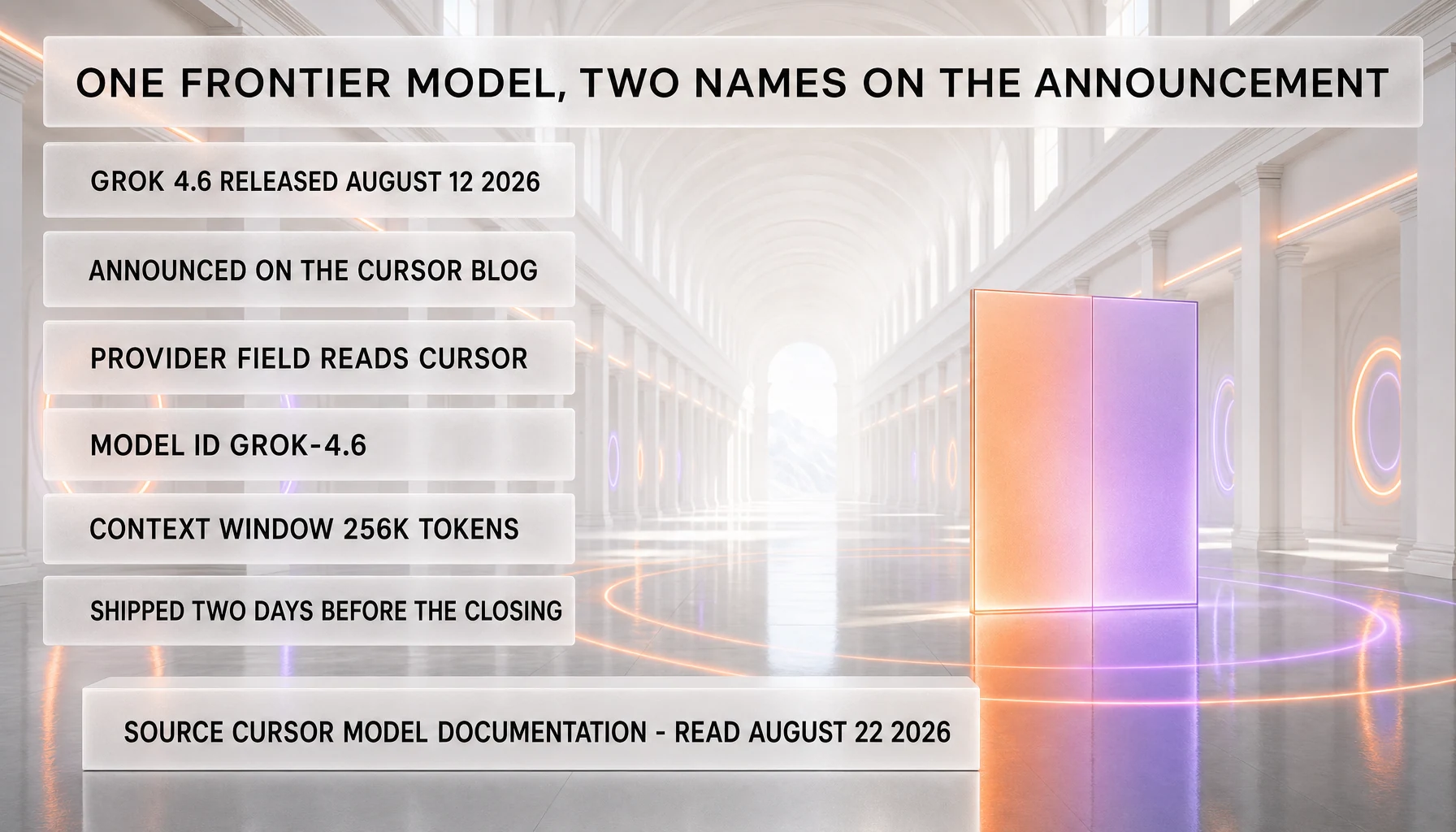
On August 12, two days before the merger became effective, Cursor published a post titled "Introducing Grok 4.6" on its own blog, filed under "research." Its first line: "Today we are releasing Grok 4.6 together with SpaceXAI." An IDE vendor announced a frontier model in the first person, on its own domain, two days before it legally belonged to the model's maker. Cursor's closing post two days later refers back to it in the same voice: "Grok 4.6, which we released Wednesday, provides an early look at what we can now build together."
The documentation went further than the blog. Cursor's model reference page for Grok 4.6 lists it with model ID grok-4.6, a 256k context window, capabilities covering agent and thinking modes, intelligence rated "Frontier," and a provider field that reads, simply, Cursor. The page's own description calls Grok 4.6 "a frontier model from Cursor and SpaceXAI for complex coding and knowledge work," built on Grok 4.5 with improved instruction following and long-horizon agentic work.
That provider field is the org chart showing through the product surface. Cursor already ships a model of its own, Composer, and routes everything else to third-party labs. Its documentation now names it as the provider of a Grok release as well.
On the model's capabilities, Cursor's post claims Grok 4.6 "matches GPT-5.6 Sol on the Artificial Analysis Intelligence Index, which is a composite score of nine benchmarks." That is the vendor's own characterization of an independent index, published by the party with an interest in the result, and the post does not state which revision of the index it was measured against. We have not independently reproduced it and are reporting it as a claim, not a finding. The same post also advertised double included usage inside Cursor and Grok Build for the first week after the August 12 release; that promotional window has since passed.
The neutrality question, answered in the billing
In June we wrote that aggressive Grok integration was the base case and sustained neutrality would be the upside surprise. The documentation now available supports a more interesting answer than either: the model menu stayed open, and the tilt moved into the meter.
Cursor's docs still state that it "supports frontier models from OpenAI, Anthropic, Google, SpaceXAI, and more." The model list is not shorter than it was: Claude Sonnet 5, Claude Opus 5, Claude Fable 5, Gemini 3.1 Pro, Gemini 3.7 Flash, GPT-5.6 Sol, GPT-5.6 Terra, GPT-5.6 Luna, Grok 4.6, Grok 4.5 and Composer 2.5 all appear. Nobody was removed.
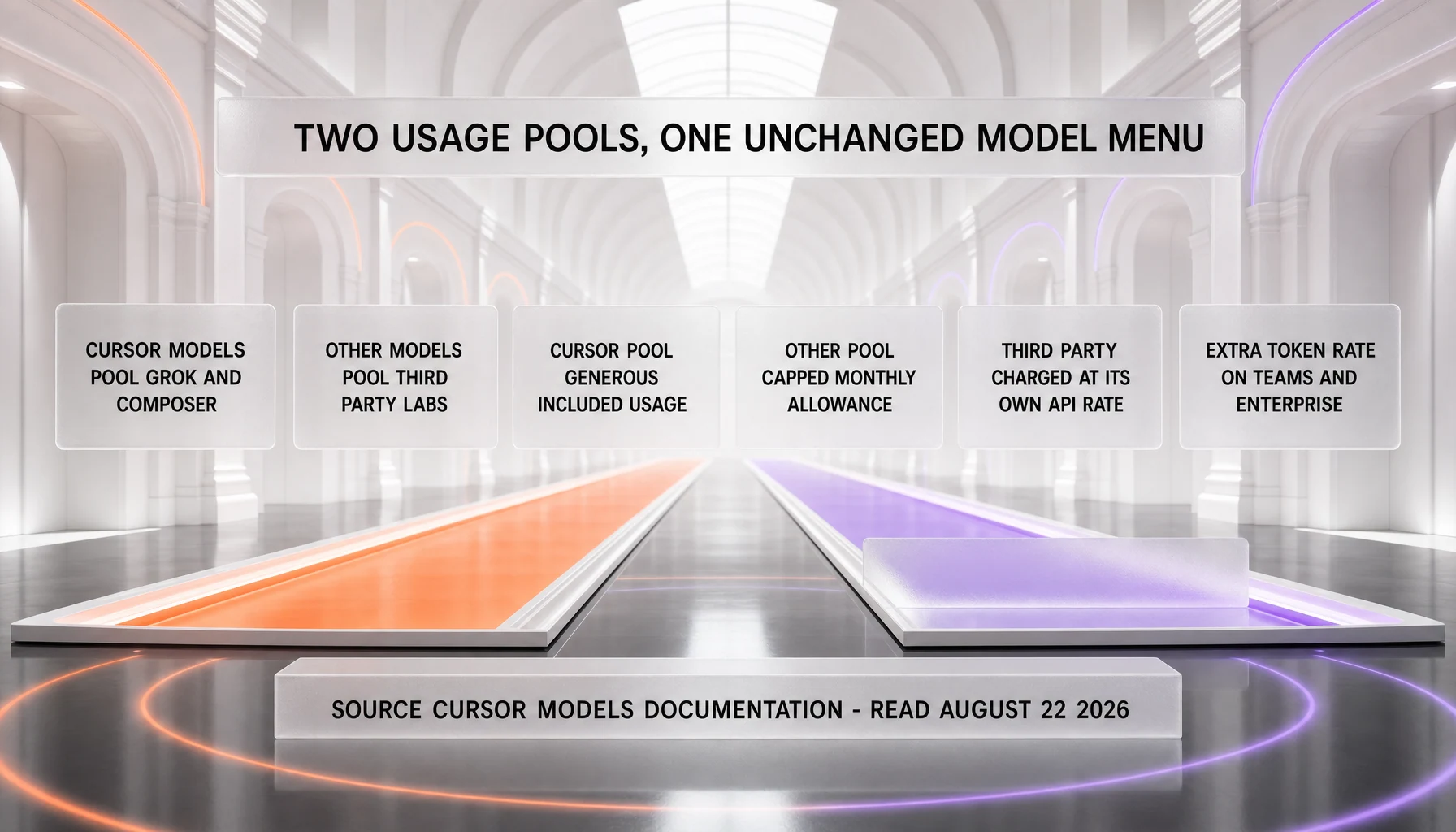
What changed is that paid usage is now split into two pools with different economics. One pool, named "Cursor Models," covers Grok 4.6, Grok 4.5 and Composer 2.5, and the docs describe it as carrying "significantly more included usage." The other pool, named "Other Models," covers everything from third-party labs, is charged at each model's API price, and comes with a fixed dollar allowance per month.
| Plan | Price | Third-party model usage included | Cursor Models pool |
|---|---|---|---|
| Start (India only) | ₹649 per month, tax inclusive | $0 | Generous included usage |
| Pro | $20 per month | $20 | Generous included usage |
| Pro+ (written "Pro Plus" in the docs) | $60 per month | $70 | Generous included usage |
| Ultra | $200 per month | $400 | Generous included usage |
Read the two right-hand columns against each other. Anthropic, OpenAI and Google models draw down a capped, dollar-denominated allowance that a heavy user can exhaust; Grok and Composer draw from a pool the vendor declines to quantify beyond "generous." A team can still route every request to Claude Opus 5 or GPT-5.6 Sol. It will simply hit a wall the Grok user does not hit, and then pay API rates on top of the subscription.
There is a second, quieter asymmetry aimed squarely at companies. Cursor's docs state that on Teams and Enterprise plans, third-party model requests carry a "Cursor Token Rate" of $0.25 per million tokens, applied on top of model API pricing, and that this rate applies to included usage, on-demand usage, and bring-your-own-key usage alike. It follows the request into the automatic routing modes as well: the documentation states that the rate applies both when a developer picks a third-party model directly and when Auto Balance or Auto Intelligence routes to one, while Auto Cost and every first-party model, Grok 4.6, Grok 4.5 and Composer 2.5, are named as exempt. A surcharge that survives bring-your-own-key is not a compute pass-through. It is a per-token levy on choosing someone else's model, and the house models never pay it. One caveat on reading that figure: Cursor publishes the rate with no effective date and announces no change to it, so treat it as the rate in force on the day it was read rather than a dated commitment.
The in-house pool is also priced to be attractive on its own terms. Grok 4.6 and Grok 4.5 are both listed at $2 per million input tokens and $6 per million output tokens in their non-Fast variants, with Composer 2.5 at $0.5 and $2.5 respectively. On Teams and Enterprise plans, Cursor Router picks the model for each Auto request according to the customer's optimization mode, which puts model selection itself inside the vendor's control loop for anyone who takes the default.
This is the shape the June article guessed at, made concrete: multi-model support preserved on paper, with the defaults, the allowances and the surcharges all pointing the same direction. Teams that adopted Cursor specifically to avoid model lock-in still have the choice. It now has a line item.
The subscriptions merged too
Billing systems are usually the last thing to merge after an acquisition. Here it took a week.
On August 21, SpaceXAI published a note titled "Grok Bot is now included with more plans." Grok Bot had launched in beta on August 11, one day before the joint Grok 4.6 release and three days before the close. The August 21 expansion lists the plans it now ships with: SuperGrok Plus, SuperGrok Heavy, Cursor Pro+, Cursor Ultra, and Cursor Teams plans in both Standard and Premium. Enterprise customers were pointed to a waitlist while access ramps.
Cursor's own pricing page corroborates it from the other side: "Access to Grok Bot" appears as a listed feature on Pro+, Ultra, Teams Standard and Teams Premium, and does not appear on Pro or the free Hobby tier. Grok Bot itself is a desktop product, offered for download on macOS, that runs agents with their own always-on cloud computer, browser and terminal access, and the ability to sign into a user's applications.
Two entitlement systems that were separate on August 13 now grant each other's products. For a subscriber, the practical read is simple: the $60 per month Cursor tier and the $200 per month Cursor tier now buy a SpaceXAI product, and SuperGrok tiers now appear in the same entitlement list as Cursor tiers. That is a single commercial entity, whatever the org chart says.
Cursor opens a second front, this one on GitHub
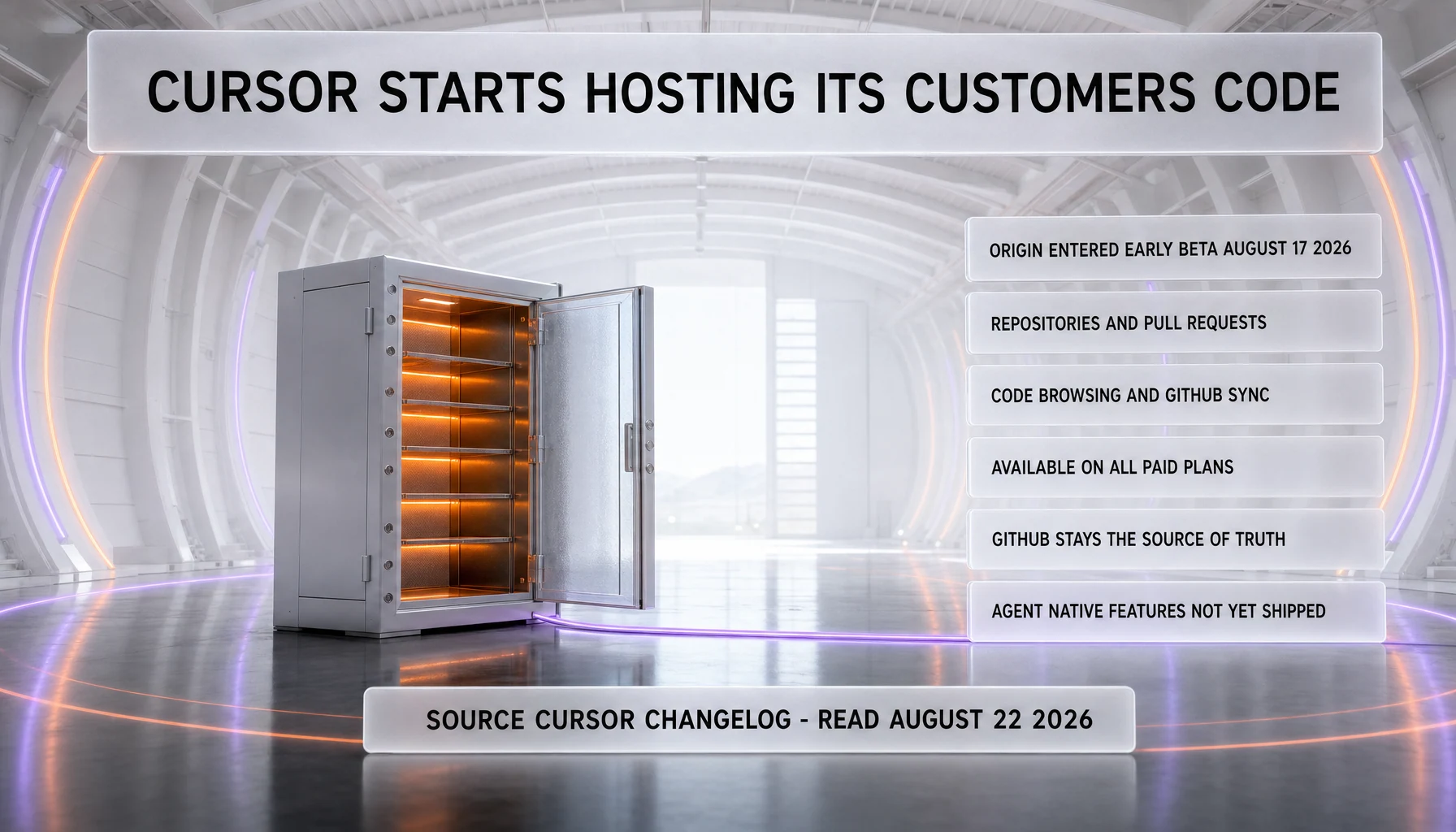
While merging upward into SpaceXAI, Cursor spent the same fortnight attacking a different incumbent. On August 17 it shipped Origin Code Hosting, described in its changelog with four words: "Cursor can now host your code." Cursor's blog is blunter about the ambition, calling Origin "our Git forge built for the agentic era."
Origin entered early beta on all paid plans, excluding enterprise organizations whose administrators opt out. The first release covers repositories, pull requests, code browsing and GitHub sync, with a new Codebase tab, a CLI for cloning and pushing, and integrations with Vercel, Depot and Buildkite. Cursor says agent-native features ship soon.
It is worth being precise about how far this goes, because the changelog itself is careful. Cursor's own text states that "pushes keep going to GitHub, which stays the source of truth for anything started there," with icons distinguishing repositories Cursor hosts from those that came from GitHub. Origin is a beachhead with a sync path, not a replacement, and Cursor is not claiming otherwise in its first release.
The strategic reading is still hard to miss. Code hosting is Microsoft's territory, GitHub Copilot is the incumbent Cursor competes with most directly, and a coding tool that also holds the repository has a structural advantage over one that has to ask for access. Cursor’s own blog archive carries a December 19, 2025 post titled “Graphite is joining Cursor,” and Origin now puts repositories and pull requests under the same roof. The company that just became a SpaceX subsidiary is, in the same month, making a run at the developer platform layer.
What else shipped in the same fortnight
Two more entries round out the picture, and both point at the same ambition: agents that run without a human in the loop.
On August 19, Cursor shipped what it calls Cloud Agents and Cursor Harness improvements. Cloud agents can now subscribe to an event source such as a pull request or a Slack thread and wake when something happens, hold a goal until it is met, and stay on course through long-running sessions. Cursor's changelog says cloud agents automatically subscribe to the pull requests they create and drive them to completion, fixing continuous integration failures and addressing bot comments. Subscriptions are cloud-agent-only for now. We covered the earlier phase of this work when multi-repo agent environments and governance landed in version 3.4.
On August 13, the day before the close, three things landed at once: a changelog entry reporting that cloud agents start three times faster with builds, a blog post announcing that Cursor earned AIUC-1 certification for agent security and reliability, and a post from Maxime Prades announcing that the Firetiger team was joining Cursor. Shipping a security certification the day before an ownership change is a reasonable thing to want on the record when enterprise customers are about to ask who owns their code host.
The Firetiger item inverts the direction of the whole story. On the eve of becoming a subsidiary, Cursor announced an acquisition of its own. Firetiger, founded in 2024 by Rustam Lalkaka and Achille Roussel, builds agents that work on software after it reaches production, monitoring rollouts, catching regressions, investigating incidents and feeding what they find back to coding agents. Cursor's post groups it with Origin and a not-yet-shipped feature called Change Monitors as one investment in agents that run without supervision. The company being acquired for $60 billion spent the day before its own closing buying someone else.
Six names, one company
One practical note for anyone trying to search this story or cite it correctly. The entity now goes by at least six names across its own surfaces, and they coexist rather than resolve.
- Space Exploration Technologies Corp. is the SEC registrant and the acquirer named in the filing.
- Anysphere, Inc. is the surviving subsidiary in the filing and the copyright holder in Cursor's website footer.
- Cursor is the product, and the name the filing itself uses as shorthand for Anysphere.
- X67 Inc. was the merger subsidiary, which ceased to exist when it merged into Anysphere.
- SpaceXAI is the branding on the model and Grok Bot announcement pages, and the name Cursor uses in its own posts.
- X.AI LLC is the copyright line in the footer of those same pages.
We report that coexistence rather than picking a winner. If you are writing about the model side of this company, SpaceXAI is the name it uses on its own announcements, and we covered the point at which the rebrand became official while Grok kept its name. If you are writing about securities, it is Space Exploration Technologies Corp. Both are correct, on different documents, at the same time.
What we are not reporting
Three things circulating around this closing are not established by any primary source we could reach, and we are leaving them out rather than hedging them into the article.
The regulatory path. This is an absence of sourcing, not an absence of events. The closing 8-K records what took effect on August 14 and does not describe the conditions that preceded it, and neither company has published a statement about the regulatory history of this transaction on the pages we checked. Something may well have happened. We cannot source it, we do not fill that kind of gap with secondhand accounts, and so we report nothing about it in either direction.
Founder departures. We checked the Cursor blog, the Cursor press page, the Cursor changelog and the SpaceXAI news feed. None of the four carries an announcement about leadership changes at Cursor after the close. That is a statement about those four sources, not about what has or has not happened inside the company.
Anything about Cursor's revenue. The run-rate figures that circulated in June came from reporting on company data, not from a filing. The closing 8-K contains no revenue disclosure, so we are not refreshing that number here.
What it means if you code in Cursor
Nothing broke on August 14, and nothing in the documentation suggests anything is about to. The model picker still lists Anthropic, OpenAI and Google models. Your editor did not change. What changed is that the questions worth asking have moved from "will they" to "how much."
If you are an individual developer, the concrete number to watch is your third-party allowance. On Pro that allowance is $20 per month against a $20 subscription; on Pro+ it is $70 against $60; on Ultra it is $400 against $200. If most of your work runs on Claude or GPT models, that allowance is now the real constraint on your plan, and the Grok and Composer pool is the path the pricing is pushing you toward. Check whether the model you actually prefer sits in the capped pool before you renew.
If you run an engineering organization, the line to price into any renewal is the $0.25 per million token Cursor Token Rate on third-party models for Teams and Enterprise plans, especially the part where it applies to bring-your-own-key usage. If your compliance posture already requires you to bring your own Anthropic or OpenAI keys, you are now paying a per-token fee for that requirement. That is a negotiable term, and it is worth naming explicitly rather than discovering on an invoice.
If you are evaluating alternatives, the field is the same one we mapped in June and the argument has sharpened. Claude Code and OpenAI Codex are openly lab-owned and never claimed otherwise. Windsurf and Google Antigravity occupy the ground Cursor used to hold in the neutrality argument, and we compared that field directly in our three-way breakdown of Cursor 3, Google Antigravity and Claude Code. The honest summary is that no major AI coding tool is now independent of a model lab, so the question is not whether your editor has a house model but how visibly its pricing steers you toward it. Cursor's steering is at least documented, which is more than can be said for a routing default nobody publishes.
The broader pattern is the one this closing makes impossible to ignore. In nine days, a coding tool went from being a company that bought inference to being a company that ships a frontier model under its own byline, sells a rocket company's agent product inside its own subscription tiers, and hosts its customers' repositories. Ownership changed on one date. The product stopped being separable on several.
Frequently asked questions
Is the SpaceX acquisition of Cursor complete?
Yes. SpaceX's Form 8-K states that the merger became effective on August 14, 2026, and that Anysphere, Inc., the maker of Cursor, survives as a wholly owned subsidiary of Space Exploration Technologies Corp. This is different from the June 16, 2026 announcement, which was the signing of the merger agreement rather than the transfer of ownership. Cursor confirmed the closing on its own blog the same day.
How many SpaceX shares did Cursor shareholders receive?
Cursor's common and preferred stock converted into an aggregate of 389,289,254 shares of SpaceX Class A common stock, based on an implied Cursor equity value of $60.0 billion. Vested Cursor restricted stock units converted into a further 1,752,426 shares before tax withholding. SpaceX also assumed approximately 29,128,326 restricted stock units and approximately 44,365,047 stock options, which may be delivered later as they vest or are exercised.
Where does the $60 billion figure come from?
It comes from SpaceX's SEC filing, not from Cursor. The 8-K states that the share consideration was calculated on an implied equity value of Cursor of $60.0 billion, a value fixed by the June 16, 2026 merger agreement. Cursor's own announcement of the closing does not mention any dollar amount. If you see the figure attributed to Cursor's blog post, it did not originate there.
Does Cursor still support Claude, GPT and Gemini models?
Yes. Cursor's documentation states that it supports frontier models from OpenAI, Anthropic, Google, SpaceXAI and more, and its model list includes Claude Sonnet 5, Claude Opus 5, Claude Fable 5, Gemini 3.1 Pro, Gemini 3.7 Flash, GPT-5.6 Sol, GPT-5.6 Terra and GPT-5.6 Luna alongside Grok 4.6, Grok 4.5 and Composer 2.5. No model was removed after the close. What changed is how usage of those models is metered.
What are Cursor's two usage pools?
Cursor splits paid usage into a "Cursor Models" pool covering Grok 4.6, Grok 4.5 and Composer 2.5, which the documentation describes as carrying significantly more included usage, and an "Other Models" pool for third-party models charged at each model's API price with a fixed monthly dollar allowance. That allowance is $20 on Pro, $70 on Pro+ and $400 on Ultra. The Start plan, offered in India, does not include the third-party pool at all.
What is the Cursor Token Rate?
According to Cursor's documentation, third-party model requests on Teams and Enterprise plans carry a Cursor Token Rate of $0.25 per million tokens, applied on top of the model's own API pricing. The documentation states that this rate applies to included usage, on-demand usage and bring-your-own-key usage. It does not apply to the Cursor Models pool, which covers Grok and Composer.
Which Cursor plans include Grok Bot?
SpaceXAI announced on August 21, 2026 that Grok Bot is included with SuperGrok Plus, SuperGrok Heavy, Cursor Pro+, Cursor Ultra and Cursor Teams plans in both Standard and Premium. Cursor's pricing page lists access to Grok Bot as a feature on those same Cursor tiers and does not list it on the Pro or free Hobby tiers. Enterprise customers were directed to a waitlist while access ramps.
Who released Grok 4.6, Cursor or SpaceXAI?
Both, by their own account. Cursor published a post titled "Introducing Grok 4.6" on its own blog on August 12, 2026, opening with the line "Today we are releasing Grok 4.6 together with SpaceXAI." Cursor's model documentation lists Grok 4.6 with a provider field of Cursor and describes it as a frontier model from Cursor and SpaceXAI. The release landed two days before the merger legally took effect.
What is Origin Code Hosting?
Origin is Cursor's own code hosting service, announced in its changelog on August 17, 2026 with the line "Cursor can now host your code." It entered early beta on all paid plans, excluding enterprise organizations whose administrators opt out, and covers repositories, pull requests, code browsing and GitHub sync, with integrations for Vercel, Depot and Buildkite. Cursor's changelog states that pushes keep going to GitHub, which remains the source of truth for anything started there.
How much does Cursor cost after the acquisition?
Cursor's published pricing lists a free Hobby tier, Pro at $20 per month, Pro+ at $60 per month, Ultra at $200 per month, and custom Enterprise pricing. Teams has two seat types, Standard at $40 per user per month and Premium at $120 per user per month, with Premium adding five times the Standard limits on Agent. A Start plan for developers in India is listed at ₹649 per month, tax inclusive. We found no announced price change tied to the closing itself, and no change to Cursor's licensing.
Why does the same company appear as SpaceXAI, xAI and X.AI LLC?
Because all of those names are in current use on the company's own surfaces. SpaceXAI is the branding on the model and Grok Bot announcement pages, X.AI LLC is the copyright line in the footer of those pages, Space Exploration Technologies Corp. is the SEC registrant, and Anysphere, Inc. is the surviving subsidiary named in the filing and the copyright holder on Cursor's site. We report the coexistence rather than treating any one of them as the correction of another.
How is this different from your June article on the acquisition?
Our June article covered the signing of the merger agreement on June 16, 2026, when the $60 billion valuation was set and the outcome was still pending. This article covers the closing on August 14, 2026, which is when ownership actually transferred, when the exact share count became public, and when the product integration became observable in Cursor's documentation, pricing pages and changelog rather than a matter of speculation.
Sources
- SEC EDGAR — Space Exploration Technologies Corp., Form 8-K dated August 14, 2026 (closing, share consideration, Section 4(a)(2) issuance)
- Cursor — Cursor is now a part of SpaceX (August 14, 2026)
- Cursor — Introducing Grok 4.6 (August 12, 2026)
- Cursor Docs — Models and pricing (usage pools, plan allowances, Cursor Token Rate)
- Cursor Docs — Grok 4.6 model reference (provider field, context window)
- Cursor — Pricing (plan tiers, Grok Bot entitlements)
- Cursor — Changelog (Origin Code Hosting, Cloud Agents, build speed)
- Cursor — Firetiger joins Cursor (August 13, 2026; Origin described as a Git forge)
- SpaceXAI — Grok Bot is now included with more plans (August 21, 2026)
ThePlanetTools.ai has no financial relationship with SpaceX, Anysphere, SpaceXAI, Anthropic, OpenAI, Google, Microsoft, GitHub, or any company named in this article. This is editorial reporting and analysis, not investment advice. Share counts and the implied equity value are quoted from SpaceX's Form 8-K; the derived per-share price and the 464,535,053 total are our own arithmetic from figures in that filing and are identified as such in the text.