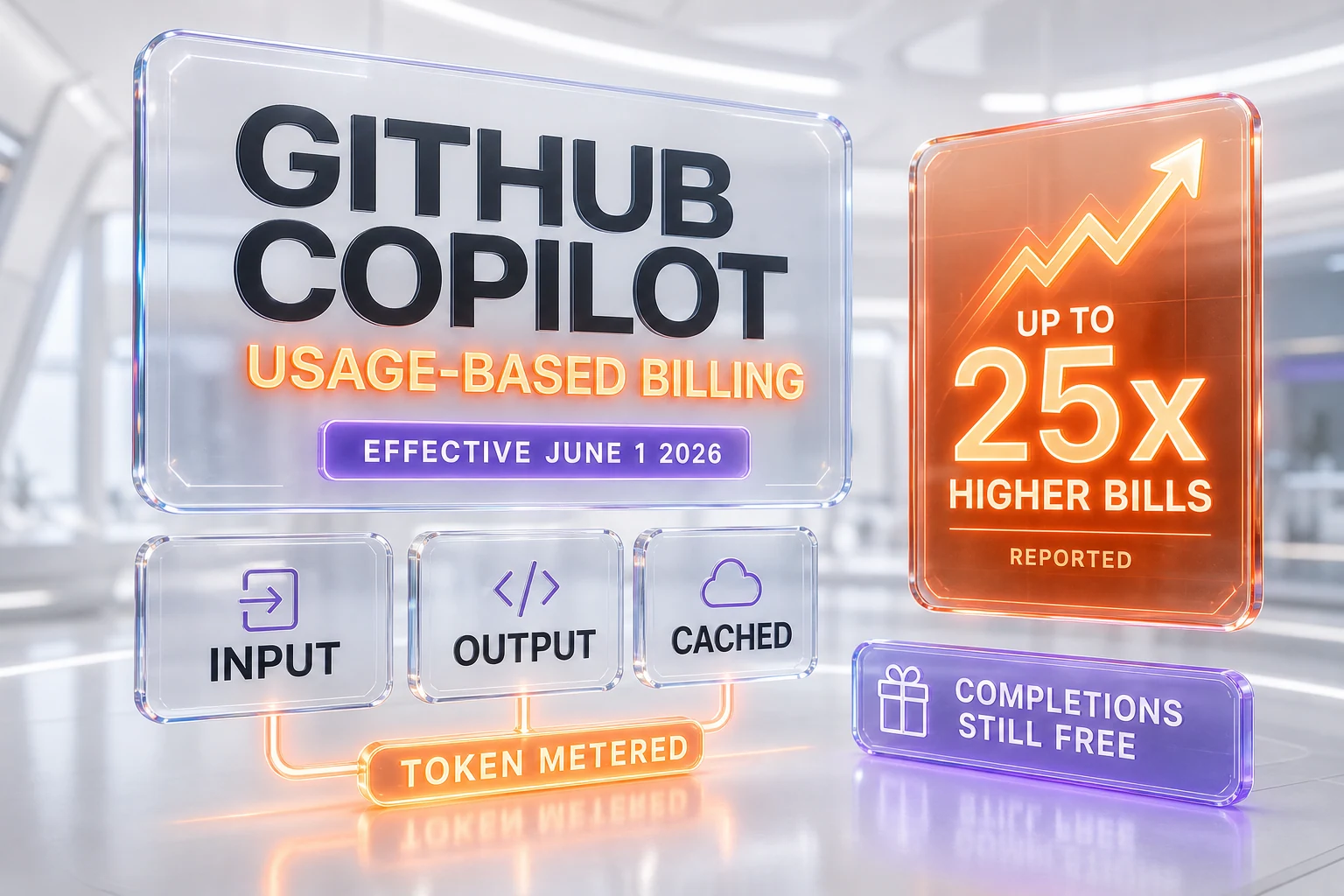
GitHub Copilot moved to usage-based "AI Credits" billing on June 1, 2026. Code completions and Next Edit suggestions stay free, but agentic and chat usage now burns metered tokens — input, output, and cached — at GitHub's published per-model rates. Plans anchor at Copilot Pro for $10 per month, Pro+ at $39 per month, and Max at $100 per month, each bundling a fixed credit allowance. Heavy users report bills jumping up to 25x, according to TechCrunch.
Bottom line up front: if you mostly autocomplete code, your bill barely moves. If you run agents, multi-file edits, and long chat sessions all day, the new meter can multiply your cost several times over — and the unpredictability is what is driving the anger.
What Actually Changed on June 1
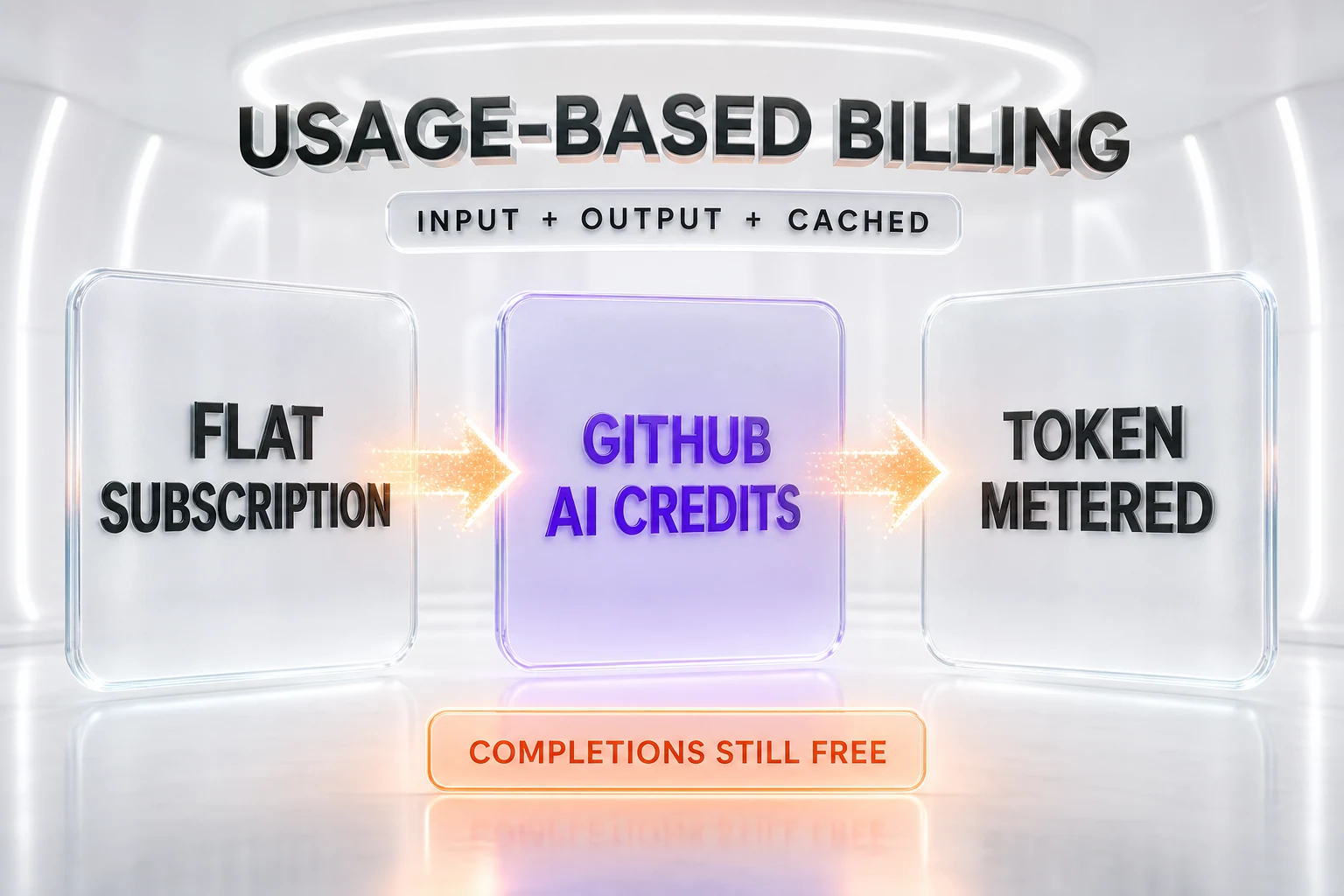
For years, GitHub Copilot was a flat-rate product: one monthly price, effectively unlimited use. As of June 1, 2026, that model is gone for the parts of Copilot that lean on large language models. GitHub now meters those interactions through a credit system it calls GitHub AI Credits, and your monthly plan includes a fixed dollar allowance of those credits. Go over the allowance and you pay for additional usage. (GitHub explained the shift on its official company blog.)
The mechanic that matters: credits are consumed based on token usage — input tokens, output tokens, and cached tokens — priced at GitHub's published per-model API rates. In other words, every prompt you send to an agent or a chat model, plus the context it reads and the answer it returns, draws down your balance. The bigger your context window and the more capable the model you select, the faster the meter runs.
There is one important carve-out that softens the blow for a large group of users. Code completions and Next Edit suggestions remain included and do not consume credits. The inline gray-text autocomplete that most people associate with Copilot is still effectively flat-rate. The metering applies to the heavier, model-hungry surfaces: Copilot Chat, agent mode, and the multi-step workflows that read and rewrite many files at once.
GitHub also adjusted availability at the individual tier. New sign-ups for Pro and Pro+ are temporarily paused; existing customers can still upgrade to Pro+ or Max. That detail has added to the sense among developers that the company is steering usage toward the higher, agent-oriented plans.
What It Really Costs: The Verified Numbers
Here is the part most write-ups get wrong by mixing projections with policy. The table below is the official, published structure — the plan prices and the included AI Credit allowances straight from GitHub's plans page and company blog. These are facts. The eye-watering numbers further down this article are developer projections, and we label them as such.
| Plan | Price per month | Included AI Credits | Notes |
|---|---|---|---|
| Copilot Free | $0 | None (2,000 completions per month) | Completions only; no metered agent allowance |
| Copilot Pro | $10 | $15 per month in AI Credits | New sign-ups temporarily paused |
| Copilot Pro+ | $39 | $70 per month in AI Credits | New sign-ups temporarily paused; existing users can upgrade |
| Copilot Max | $100 | $200 per month in AI Credits ($100 base plus $100 flex) | Built for sustained agent-driven workflows |
| Copilot Business | $19 per user per month | $30 per month promotional AI Credits (June through August 2026) | Promotional credit window for the launch period |
| Copilot Enterprise | $39 per user per month | $70 per month promotional AI Credits (June through August 2026) | Promotional credit window for the launch period |
Read the table carefully and a pattern appears. The included credit allowance scales faster than the headline price as you climb: Pro gives you $15 of credits on a $10 plan, while Max gives you $200 of credits on a $100 plan. GitHub is clearly positioning Max as the home for people who previously enjoyed unlimited agent use — and pricing the all-day agentic workflow at roughly $100 per month before any overage.
For business buyers, the promotional credits matter. Copilot Business at $19 per user per month carries $30 per month in promotional AI Credits through August 2026, and Copilot Enterprise at $39 per user per month carries $70 per month in promotional credits over the same window. Those promotional allowances cushion the transition for teams, but they are explicitly time-boxed to the June-through-August period, so finance teams should plan for the post-promo math.
Why Developers Are Revolting
The reaction was immediate and loud. TechCrunch reported that the sentiment trended on GitHub's own community forum within hours of the announcement, with one Redditor on r/GithubCopilot summing up the mood in three words: "What a joke." That line is a quoted developer reaction, not our assessment — but it captured a wave of frustration that spread fast.
The anger is rooted in specific, scary math that developers ran on their own usage. According to TechCrunch, one developer projected their cost would climb from about $29 per month to nearly $750 per month under the new metering. Another developer shared a screenshot showing costs leaping from roughly $50 to about $3,000. TechCrunch framed the impact on heavy users as bills jumping "25x." Beyond those headline cases, developer reports suggest heavy agentic users are seeing increases in the range of 10x to 50x under metering — figures that come from the community rather than from GitHub, and that we present as developer reports rather than confirmed pricing.
It is worth restating the boundary clearly: none of those multiplied figures are GitHub's official pricing. The only numbers GitHub states as policy are the plan prices and credit allowances in the table above. The $29-to-$750 jump, the $50-to-$3,000 screenshot, the "25x" framing, and the 10x-to-50x range are all projections and reports attributed to developers and reporters, describing what they expect to pay given their personal usage patterns.
Underneath the specific numbers is a deeper tension that has been building across the whole industry: AI coding is being priced like compute, not like software. Developers internalized a decade of flat-rate SaaS, where a seat costs a fixed amount no matter how hard you use it. Token metering breaks that mental model — your cost now tracks your consumption, the way a cloud bill does. We explored that exact shift in our earlier analysis of Microsoft's AI token economics and the cost of agents versus employees, and Copilot's June change is that thesis arriving on individual developers' invoices.
Is the Outrage Justified? The Nuance
The honest answer is: it depends heavily on how you actually use Copilot, and the loudest projections come from the heaviest users. A balanced read of the change cuts several ways.
First, the case for calm. Completions and Next Edit suggestions — the feature most developers touch most often — are still included and consume no credits. If your day is mostly autocomplete with occasional chat, your bill may land at the same place or even lower than before, because you are now paying closer to what you consume rather than a flat premium. Light users are not the ones posting $3,000 screenshots.
Second, the case for concern. Heavy agentic users are hit hardest, and they are hit precisely where the new model is most expensive: long-running agents that read large codebases, regenerate files, and loop through multi-step tasks burn input, output, and cached tokens continuously. For a developer who shifted their entire workflow to agent mode over the past year, a flat $10 or $39 plan was an extraordinary deal — and metering removes that subsidy.
Third, and most important, the real pain is not the average cost — it is the unpredictability. A flat subscription is trivial to budget. A metered bill that can swing from $29 to $750 depending on how many agent runs you fire in a given month is genuinely hard to plan around, both for individuals and for engineering managers signing off on team spend. Even users whose average cost stays flat lose the certainty they had, and certainty has real value. That is the legitimate core of the backlash, separate from any single dramatic screenshot.

5 Cheaper or More Predictable Alternatives
If the metering math does not work for your workflow, several competitors offer either flatter pricing or a more generous included tier before metering kicks in. Below are five options worth evaluating, with their pricing models described in plain language. Where we are not certain of a current dollar figure, we describe the model qualitatively rather than guess — pricing in this category changes fast.
1. Claude Code — the agentic CLI built around predictable plans
Claude Code is Anthropic's command-line coding agent, designed for the same multi-file, agent-driven workflows that make Copilot's new meter expensive. Its pricing is tied to Anthropic's subscription plans, which bundle a substantial usage allowance into a flat monthly fee — closer to the "pay one price, work all day" model that Copilot users are mourning. For developers who live in agent mode, a plan-based allowance can be far easier to budget than a pure token meter, because the heaviest usage is exactly what the subscription is built to absorb. If you are coming from Copilot specifically for agentic work, this is the first alternative to test. See how it stacks up directly in our Claude Code versus Cursor comparison and our Claude Code versus OpenAI Codex comparison.
2. Cursor — the AI-first IDE with a flat-rate core
Cursor is an AI-native code editor — a full IDE, not just an autocomplete layer — with deep chat, multi-file edits, and agent features built in. Its core paid tier is a flat monthly subscription, which gives teams a predictable baseline that contrasts sharply with Copilot's per-token model. Heavier or premium-model usage can move into usage-based territory, so read the current terms before you commit, but the entry point is designed around a fixed monthly price. For many ex-Copilot users, Cursor is the most natural like-for-like switch because the editing experience is so similar. Our GitHub Copilot versus Cursor comparison breaks down the differences in detail.
3. OpenAI Codex — agentic coding inside the OpenAI ecosystem
OpenAI Codex is OpenAI's coding agent, available to ChatGPT subscribers and through the API. The key point for budgeting: a meaningful amount of Codex usage is included with ChatGPT subscription plans, so if you already pay for ChatGPT, a large share of your coding agent usage may be bundled into a price you are already paying. That bundling can make total cost more predictable than a standalone token meter, especially for developers who use the same subscription for general assistant work. As always, confirm current limits, since included allowances are adjusted over time.
4. Windsurf — agentic IDE with subscription-anchored pricing
Windsurf is another AI-first IDE with strong agent capabilities, positioned squarely against Cursor and Copilot. It anchors on a flat monthly subscription for its main tier, with heavier agent actions metered on top — a hybrid that still gives you a fixed, knowable floor each month. For teams that want an agentic editor but flinch at a pure pay-per-token bill, that predictable base can be the deciding factor. If your workflow is closer to fully autonomous, agent-driven development, it is also worth looking at Devin, the autonomous software engineering agent, though it targets a different, more hands-off use case than a daily coding assistant.
5. Kimi K2.6 — the open-weight option you can self-host or run cheaply
For developers who want to escape vendor metering entirely, Kimi K2.6 is an open-weight model you can self-host or access through low-cost API providers. The pricing model here is fundamentally different: instead of buying credits from a single vendor, you either run the weights on your own infrastructure or pay competitive open-model API rates, which are typically a fraction of frontier proprietary pricing. Open-weight CLI options like Kimi K2.6 — and broadly similar offerings such as Zhipu's GLM-family command-line tooling — give cost-sensitive and privacy-sensitive teams a path where the bill is governed by your own hardware or a cheap inference provider rather than a metered credit balance. It demands more setup than a polished commercial product, but it is the most direct way to take control of cost.
How to Audit Your Own Copilot Spend
Before you cancel anything or panic at a projection, run your own numbers. The dramatic figures circulating online belong to specific heavy users; your reality may be far milder. Here is a practical checklist to find out where you actually stand under the new model.
- Separate completions from agent usage. Completions and Next Edit suggestions are free. Estimate what share of your daily Copilot interaction is plain autocomplete versus chat and agent runs — only the latter consumes credits.
- Count your agent sessions per week. Multi-step agent runs over large codebases are the single biggest credit driver. If you fire only a handful per week, your exposure is low; if you run them constantly, you are in the high-variance zone.
- Watch your model selection. More capable models cost more per token. If you default everything to the largest model, switching routine tasks to a smaller one can cut credit burn substantially.
- Mind the context size. Because input and cached tokens count, dragging huge files or whole directories into context on every prompt inflates cost. Trim the context you actually need.
- Map your usage against the included allowance. Compare your estimated monthly credit burn to the $15 (Pro), $70 (Pro+), or $200 (Max) allowance. If you comfortably fit inside the allowance, the new model may cost you nothing extra.
- Set a budget alert. Treat metered AI like any cloud service: turn on spend notifications so a runaway agent loop cannot quietly run up a bill before you notice.
- Run a one-week trial of an alternative. Before committing, test a flat-rate option like Cursor or a plan-based agent like Claude Code on a real task and compare the experience against your metered Copilot estimate.

Who Should Stay on Copilot — and Who Should Switch
The change does not point everyone toward the door. For some developers, Copilot remains the right call; for others, the new meter is a genuine reason to move. Here is the practical split.
Stay on Copilot if your work is dominated by inline completions and light chat. Those completions are still free, the Pro plan at $10 per month includes $15 in credits, and the editor integration is mature and deeply wired into the GitHub ecosystem. If you fit comfortably inside your included allowance most months, the metering is a non-event and switching tools would cost you more in friction than you would save.
Consider switching if you run agents and multi-file edits as your primary mode of work, or if you manage a team where unpredictable monthly bills are a budgeting headache. Heavy agentic users are exactly the group the meter hits hardest, and that is where a plan-based agent like Claude Code or a flat-rate IDE like Cursor can restore the predictability you lost. Cost-sensitive teams that can absorb extra setup should also weigh an open-weight route such as Kimi K2.6, where the bill is governed by your own infrastructure rather than a vendor's credit meter.
The decision is not loyalty versus betrayal — it is matching your usage pattern to a pricing model. Run the audit in the previous section first; the answer is usually obvious once you see your real agent-versus-completion ratio.
What's Next
Copilot's move is less an outlier than a signal. As frontier models grow more capable and more expensive to run, the economics of flat-rate, effectively-unlimited AI coding become harder to sustain — and metered, consumption-based pricing starts to look like the industry's direction of travel rather than a one-off decision. Expect more vendors to introduce credit systems, included allowances, and overage tiers over the coming months.
The strategic question for developers is no longer "which tool has the best autocomplete" but "which pricing model matches how I actually work." If you are a light user, the metered world may barely touch you. If you are a heavy agentic user, the value increasingly lives in tools that bundle generous allowances into a predictable plan, or in open-weight options you control end to end. Watch how Cursor, Anthropic, and OpenAI respond: whether they hold the line on flatter pricing to win defectors, or follow Copilot toward the meter, will shape what AI coding costs for everyone in 2027.
One thing worth watching closely is the corporate signal. Microsoft, which owns GitHub, did not respond to TechCrunch's request for comment by publication time. How loudly the company defends — or quietly adjusts — the new model in the weeks ahead will tell developers a great deal about whether the June 1 pricing is a fixed destination or a first draft.
Frequently Asked Questions
How much does GitHub Copilot cost after the June 2026 billing change?
Copilot's individual plans are Copilot Free at $0 per month, Copilot Pro at $10 per month with $15 in included AI Credits, Copilot Pro+ at $39 per month with $70 in credits, and Copilot Max at $100 per month with $200 in credits. Business is $19 per user per month and Enterprise is $39 per user per month, each with promotional credits from June through August 2026. Token usage beyond the included allowance is billed on top.
What are GitHub AI Credits?
GitHub AI Credits are the unit of the new usage-based system. Each plan includes a fixed dollar allowance of credits, and credits are consumed based on token usage — input, output, and cached tokens — priced at GitHub's published per-model API rates. When you exhaust the included allowance, additional usage draws on overage at those same rates.
Do code completions still consume credits?
No. Code completions and Next Edit suggestions remain included and do not consume AI Credits. The metering applies to model-heavy surfaces such as Copilot Chat and agent mode. If your usage is mostly inline autocomplete, the new billing has little effect on your cost.
Why are developers angry about Copilot's new pricing?
Developers are reacting to the shift from a predictable flat subscription to a metered bill that tracks consumption. According to TechCrunch, one developer projected a jump from about $29 to nearly $750 per month, and another shared a screenshot showing roughly $50 climbing to about $3,000, with heavy-user bills framed as rising "25x." The core frustration is unpredictability and the sense that AI coding is now priced like compute rather than like software.
How much is Copilot Max?
Copilot Max is $100 per month and includes $200 per month in GitHub AI Credits, structured as a $100 base plus $100 flex. GitHub positions Max for sustained, agent-driven workflows — effectively the home for users who previously relied on heavy, near-unlimited agent usage under the old flat model.
Is Claude Code cheaper than GitHub Copilot?
It depends on your usage, but Claude Code's plan-based pricing bundles a substantial usage allowance into a flat monthly fee, which can be more predictable than Copilot's per-token meter for heavy agentic work. We do not quote a fixed dollar comparison here because both vendors adjust pricing frequently; the practical move is to estimate your agent usage and test Claude Code on a real task. See our Claude Code versus OpenAI Codex and Claude Code versus Cursor comparisons for detail.
Is Cursor a good Copilot alternative?
For many developers, yes. Cursor is an AI-first IDE with chat, multi-file edits, and agent features, and its core paid tier is a flat monthly subscription, giving a predictable baseline that contrasts with Copilot's metering. Premium-model or heavier usage can move into usage-based territory, so confirm current terms, but the editing experience is close enough to Copilot to make it a natural switch.
Does Copilot's token billing affect light users?
Light users are the least affected. Because completions stay free and each plan includes a credit allowance, a developer who mostly autocompletes with occasional chat may pay the same as before or even less. The heavy cost increases reported online come from users running agents and multi-file edits all day, not from typical autocomplete-focused use.
What is the best GitHub Copilot alternative for agentic coding?
For agent-driven, multi-file workflows, the strongest alternatives are plan-based agents and AI-first IDEs that bundle generous usage into a flat fee — Claude Code, Cursor, and Windsurf are the leading options, with OpenAI Codex appealing if you already subscribe to ChatGPT. Developers who want to avoid vendor metering entirely can self-host an open-weight model such as Kimi K2.6. The best choice depends on whether you value a polished commercial experience or maximum cost control.
Did Microsoft respond to the backlash?
Microsoft, which owns GitHub, did not respond to TechCrunch's request for comment by publication time. Whether the company defends the new pricing or adjusts it in the weeks ahead is a key signal for developers deciding whether to stay on Copilot or switch.
When did Copilot's usage-based billing take effect?
The usage-based AI Credits model took effect on June 1, 2026. From that date, agentic and chat usage began consuming metered tokens, while code completions and Next Edit suggestions remained included at no extra credit cost.
Can I still use the old flat-rate Copilot plan?
No. The usage-based AI Credits model replaced the previous flat-rate structure for model-heavy features as of June 1, 2026. There is no opt-out back to the old unlimited model; the closest equivalent for heavy users is Copilot Max, which bundles the largest credit allowance ($200 per month) into a $100 monthly price. New sign-ups for Pro and Pro+ are also temporarily paused, though existing customers can upgrade to Pro+ or Max.